




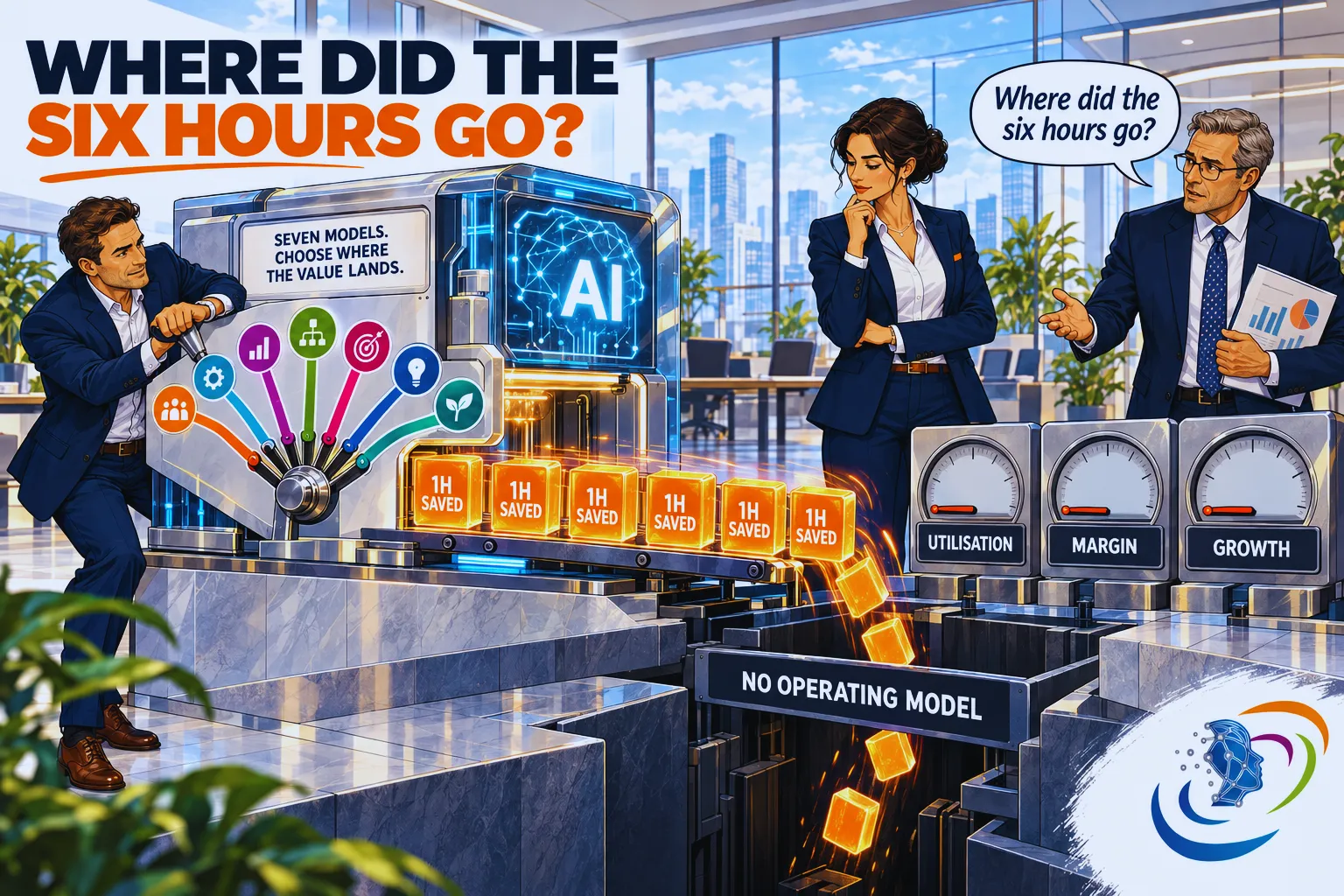


The first rung: why AI productivity gains never reach the P&L
Eighty percent of employees say AI has made them more productive. Thirty-seven percent of companies can find any of it in EBIT, and that share has not moved in a year. Most AI programmes are standing on the first rung of a four-rung ladder and calling it a climb. The ladder, the pilot that never ends, the profile post-sales organisations are missing, and five moves for the executive committee.
In McKinsey's 2026 State of AI survey, published in August 2026 and built on 1,719 respondents in 97 countries, 80% of people say AI has improved their individual productivity. 37% of organisations attribute any EBIT impact at all to AI, essentially unchanged from the previous year. 6% attribute at least 5% of EBIT to it and describe the impact as significant, a share that has not moved either. Meanwhile 44% of organisations say they are scaling AI across the enterprise, up from 38%, and 60% expect to increase their AI investment next year.
Read those numbers together and one conclusion follows. Adoption is no longer the problem. Eight people in ten are faster. Fewer than four companies in ten have anything to show for it on the income statement, and the spend keeps rising anyway.
The ladder, as a software executive drew it
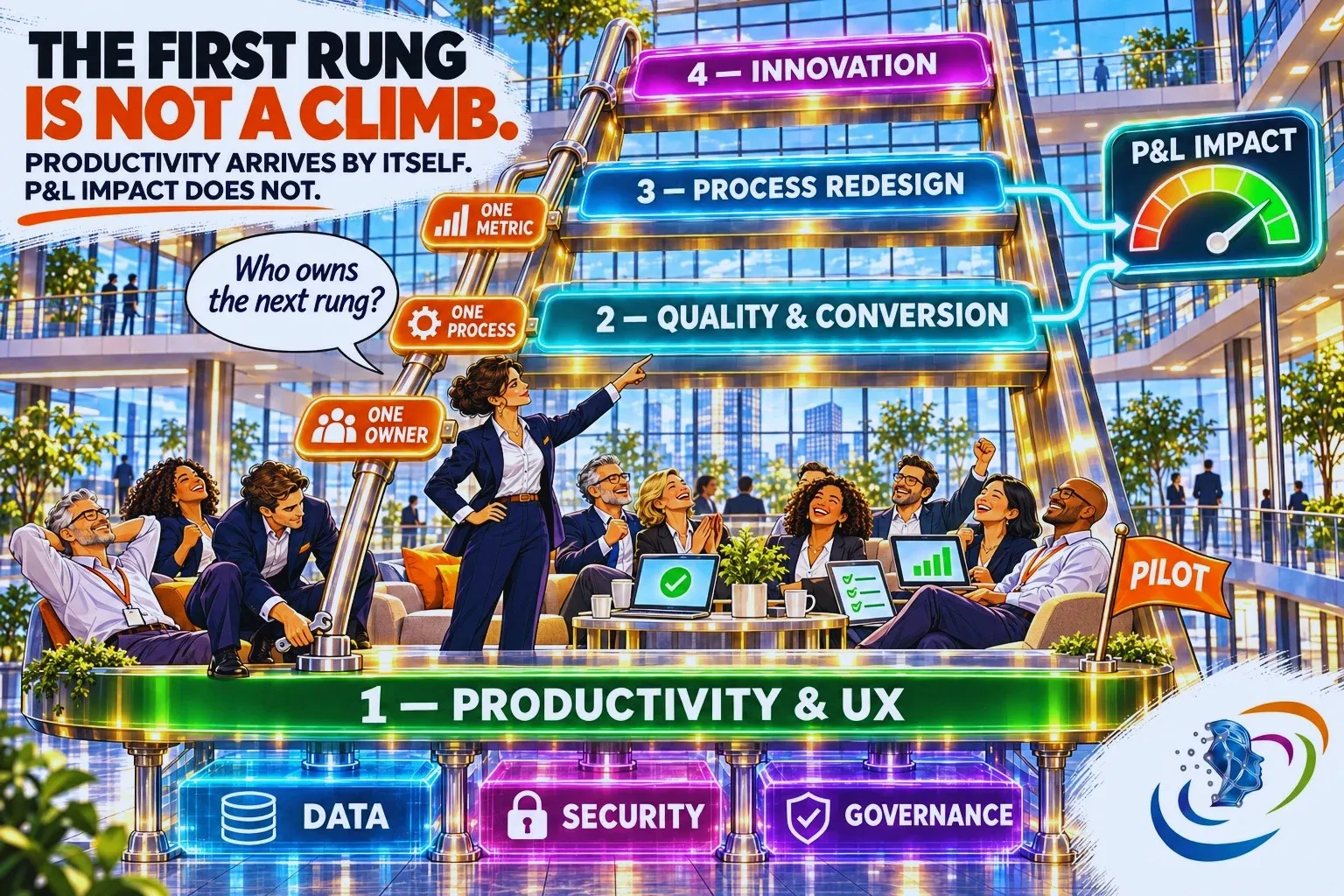
I recently spent an hour with the head of the French operation of one of the largest software companies in the world. At some point she stopped talking about products altogether and drew a ladder.
Rung one: productivity and user experience. People get faster, the tool is pleasant, everyone is pleased. Rung two: quality and conversion. The work gets better, not only quicker, and something in the funnel moves. Rung three: processes. The enterprise ones, the financial ones, the industrial ones, redesigned around what the machine can now do. Rung four: innovation. Her example was a materials group using models to find molecules that did not exist the year before. Under all four rungs, the floor: data, security, governance. Nothing stands without it.
Then she said the sentence that made me write this article. Most companies are waiting for a magic solution instead of deciding what they want to accomplish and what value they expect from it.
I recognised the ladder at once, because I had fallen off it. Some years ago, at a company I worked for whose buyers were mostly marketing leaders, we closed a large account on a productivity story: campaigns out in days instead of weeks, two agencies fewer, content volume multiplied. Every word of it was true, and eighteen months later every word of it was irrelevant, because the renewal landed on the desk of a CFO who asked one question: what had changed in conversion. We had the first rung measured to the decimal point and nothing on the second. We kept the account, with a discount, and with a commitment that should have been in the original contract: that our services team would own the second rung, with a number attached.
The capital problem of AI adoption is not adoption
We tell ourselves the AI problem is adoption. Or change management. Or the model. Or the data. I no longer believe any of that. Those are symptoms.
The root problem is the first rung. Individual productivity is the only rung of the ladder that arrives by itself, and the only one that never reaches the P&L. It arrives by itself because it asks nothing of the organisation: no process is redesigned, no decision is retired, no cost line moves. It never reaches the P&L for exactly the same reason.
Time saved by an individual is absorbed by the individual. The hour that AI gives back to a controller becomes a longer reconciliation, a cleaner deck, an earlier train home. All of it is real and none of it is money, until someone takes the hour out of the process instead of handing it back to the person.
McKinsey's data says so in its own terms. Nearly three quarters of the companies it calls AI high performers have fundamentally redesigned workflows because of AI, against one quarter of everyone else. High performers are also twice as likely to have a defined process for measuring the impact of their AI initiatives, and twice as likely to have senior leaders visibly committed to them. Redesign, measure, own. None of the three is a feature of the tool.
The pilot that never ends
The ladder explains something I had watched for years without a word for it: the pilot that never ends.
A pilot is launched to prove that the technology works. Within six weeks it has. The tool answers, the users like it, the first rung is reached and photographed for the steering committee. Then the pilot continues, month after month, because nobody wrote down which rung it was meant to reach, in which process, with which number.
MIT's NANDA group measured this in 2025 across enterprise generative AI pilots: 95% showed no measurable P&L impact. The same research found that mid-market companies move from pilot to full deployment in about 90 days, while large enterprises take nine months or longer. The technology is identical. The mid-market company simply cannot afford a pilot that ends without a decision.
I have come to distrust any pilot older than a quarter. A pilot that has reached the first rung and has not been asked to attempt the second is not a pilot. It is a demo with a budget line.
The profile post-sales is missing
Vendors are rebuilding post-sales around the ladder, whether they say so or not. On one side, architects, cloud and security specialists, solution engineers, and hundreds of customer success managers organised by solution. On the other, account managers who are, by the vendors' own admission, less and less technical. In between, a gap shaped like a person: the one who can read the customer's floor, read the customer's P&L and hold a conversation with the customer's engineer in the same hour.
That profile is scarce everywhere, and it is the one rungs two and three require, because moving a process is not a configuration task. It is a negotiation with the people who own the process.
Every post-sales organisation I have run in the past was staffed for rung one: onboarding, enablement, usage curves, ticket queues, a QBR with an adoption chart. Good people doing exactly what they were measured on. Rungs two and three need a different person and a different mandate.
In Europe, the floor has one more plank: sovereignty. Where the data sits, under which law, and who can be compelled to hand it over is now a board question. A post-sales team that cannot answer it does not get to discuss the second rung at all.
The objection: start with productivity, the rest will follow
Every time I make this argument the objection is the same. You have to start somewhere. Productivity gets the licences in and the users convinced, the budget renews, and the process work comes once people trust the tool.
I would accept it if the data showed a lag. It does not. The share of companies with EBIT impact has been flat for two consecutive surveys while adoption and scaling went up. The first rung is not a stage. It is a plateau, and a comfortable one: everyone is faster, nobody is accountable, and the bill arrives before the second rung does. One organisation in five already reports that AI operating costs, tokens included, are constraining its use.
The rest does not follow productivity. The rest follows a decision, taken by a named executive, about one process and one number. Productivity is where that decision gets postponed.
Five decisions for the executive committee
If I were structuring this for a company this quarter, five moves.
- Name the rung before the budget. For every AI line in the plan, write down the rung it is expected to reach within twelve months, the process it touches, the metric and the executive who owns it. A line without a rung is a productivity line, and should be sized as one. the target before the budget. For each AI line item in the plan, specify the target it must reach within twelve months, the process it affects, the metric and the executive responsible for it. A line item without a target is a productivity line item and must be scaled accordingly.
- Write the rung into the contract. On the vendor side, the account team and the services team name the rung the deployment is expected to reach, with its metric and its owner on the customer side, before signature. If nobody on the customer side will own a rung-two metric, you have sold rung one. Price it, and staff it, as such.
- Give every pilot a clock and a rung. Ninety days, one process, one number, then a decision: deploy, stop, or redesign. Not extend.
- Put one person per account on the ladder rather than on the queue. Not the CSM who tracks logins, not the architect who tracks the platform: the one who can read the floor, the P&L and the engineer in the same meeting. Pay for that person, and measure them on rungs reached, not on usage.
- Build the floor before the fourth rung is mentioned. Data, security, governance, and in Europe sovereignty, are not a workstream beside the AI programme. They are what the programme stands on, and the first thing a serious CFO or regulator will ask about.
The first rung, redefined
Stop asking whether your people are using the tool. They are, and eight in ten will tell you it makes them faster.
The real question is which rung your largest deployment is standing on, and who owns the next one. The first rung feels like progress because it is the only one you can reach without changing anything. Everything that reaches the P&L starts on the second.
Name the rung. Then name the owner.
This article is adapted from edition of my LinkedIn newsletter, Professional Services & Tech. Subscribe on LinkedIn to receive future editions.
Sources:
McKinsey, The state of AI in 2026: On the road to ROI (25 August 2026), global survey of 1,719 respondents in 97 countries ;
MIT NANDA, The GenAI Divide: State of AI in Business 2025 (July 2025), as reported by Fortune on 18 August 2025.
Mathilde HENRY
Executive Leader in Enterprise Software & AI Transformation. 20 years working at the intersection of software, consulting and business transformation.