

Why customer value has become software's most profitable line
How enterprise software's oldest trade-off quietly collapsed, and why Customer Success now sits on the industry's most important fault line.
Fifteen percentage points.
That is the entire distance between a software company valued at 24 times revenue and one valued at 5 times.
Not a breakthrough product. Not a heroic sales year. Fifteen points of net revenue retention: 113% for the top quartile of B2B software companies, 98% for the bottom quartile, according to the latest McKinsey benchmark covering 98 SaaS companies and more than 100 sales leaders.
For twenty years, our industry has lived with a silent contradiction. Every vendor's homepage proclaims "customer first." Every forecast review says renewal, upsell, expansion, at almost any price. We have managed customer value and vendor profitability as a trade-off, to be balanced quarter after quarter, usually in the quarter's favor.
The data now says something more uncomfortable: that trade-off was always a fiction, but only on a ten-year horizon. Extraction pays this quarter. Value pays for the decade. And the market has started putting a price on the difference.
An industry built on a trade-off
The tension is as old as the industry itself. In the perpetual-license era, the vendor was paid in full before the customer had seen a single result, then collected 18 to 22% in maintenance on software that was often half-deployed. SaaS was supposed to fix that: pay as you use, leave when it stops working, incentives finally aligned.
The theory of SaaS was alignment. The practice of SaaS, too often, was lock-in with better UX. Multi-year commitments signed in exchange for discounts. Auto-renewal clauses doing the work that value should have done. Shelfware tolerated as long as the invoice got paid. Renewal conversations run as pressure exercises rather than value reviews. None of this is illegal, and almost all of it is rational in the short term. A vendor whose only goal is to make money this year will do every one of these things, and for fifteen years capital markets rewarded exactly that behavior.
What changed is not vendors' morality. It is that the two sources of forgiveness disappeared at the same time: cheap capital, which forgave inefficient growth, and high switching costs, which forgave mediocre value.
Why extraction no longer pays
Three forces have closed the trap.
- Investors repriced growth. The market no longer pays for growth at any cost; it pays for efficient, recurring, expandable revenue. That is why the NRR gap between quartiles translates into a valuation gap of 24x versus 5x enterprise value to revenue, and why NRR leaders hold their multiples in bull and bear markets alike. Durability has become the product the market buys.
- Customers repriced trust. McKinsey finds that 80% of B2B decision-makers will look for a new vendor if performance is not guaranteed. Read that number again: the majority of your customers now expect you to guarantee outcomes, not just deliver features. The era when the customer carried all the value risk alone is ending.
AI repriced the cost of switching. Migration, integration, and retraining were enterprise software's real moats. Agents are quietly dismantling all three. When switching becomes cheap, the installed base stops being captive and becomes a constituency. It votes every twelve months.
Net revenue retention, the honesty metric
For readers outside the software industry: net revenue retention measures how much revenue a vendor keeps and grows within its existing customer base, after subtracting churn and downgrades and adding in expansions. Above 100%, your installed base grows on its own. Below it, you are filling a leaky bucket.
I have come to see NRR as the honesty metric: it compresses every promise your company has ever made into a single number. It is what your installed base thinks of you, expressed as a price. You can inflate bookings with discounts and inflate logos with thin contracts. You cannot durably inflate NRR, because it is calculated on customers who already know you.
The McKinsey benchmark is precise about what actually moves it. Companies that baseline, track, and communicate customer ROI in a disciplined way post roughly 7 more points of NRR than their peers. Best-in-class pricing and packaging discipline is worth about 16 points. Rigorous performance management adds 15, and granular NRR reporting another 13. These are not surface correlations; this is the mechanics of compounding.
Now the uncomfortable part: only 18% of the companies surveyed have a sophisticated value-realization journey, and barely 3% operate a best-in-class coverage model. The industry knows the words. Very few practice the discipline. Which means the biggest arbitrage available in enterprise software today is not a technology. It is operationalizing honesty before your competitors do.
Customer Success on the fault line
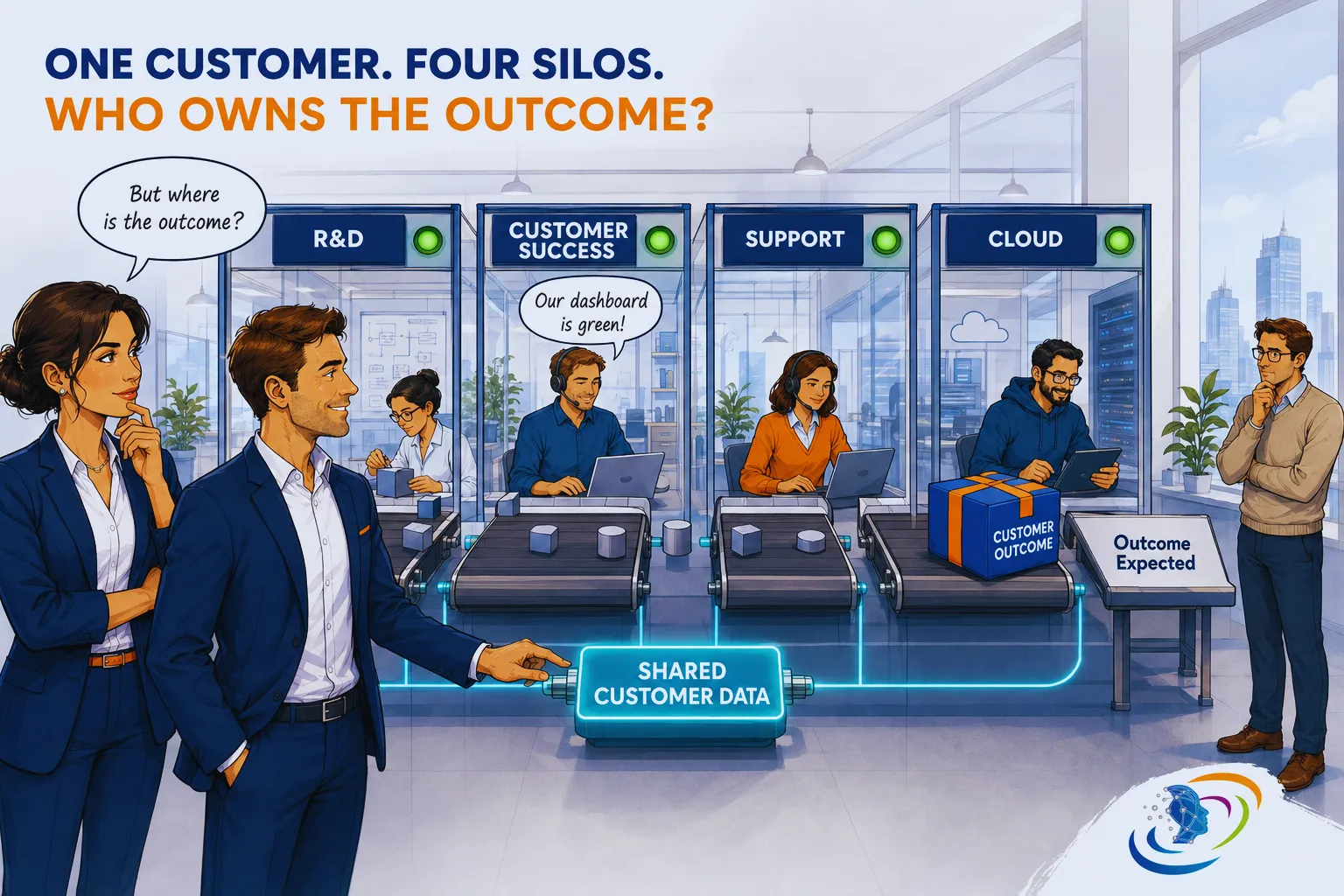
No function embodies this tension more completely than Customer Success. It was born around 2005 as churn insurance: a cost center tasked with plugging the leaky bucket. Then the industry did the math. One-third to one-half of revenue growth at the best software companies comes from existing customers, at a fraction of the cost of acquiring new logos. So CS was rebranded as a growth engine, handed expansion targets, and pulled ever closer to the revenue line.
The result is a function in structural identity conflict. In a 2025 ChurnZero study, 59% of CS professionals say their company values Customer Success less than sales. The fastest way for a CS leader to be valued internally is to carry revenue. The fastest way to carry revenue is to behave like a salesperson. And the moment the customer perceives the CSM as a seller, the trust that made expansion possible disappears. McKinsey named this paradox a decade ago: a growth motion customers perceive as profit-driven destroys the very relationship it monetizes.
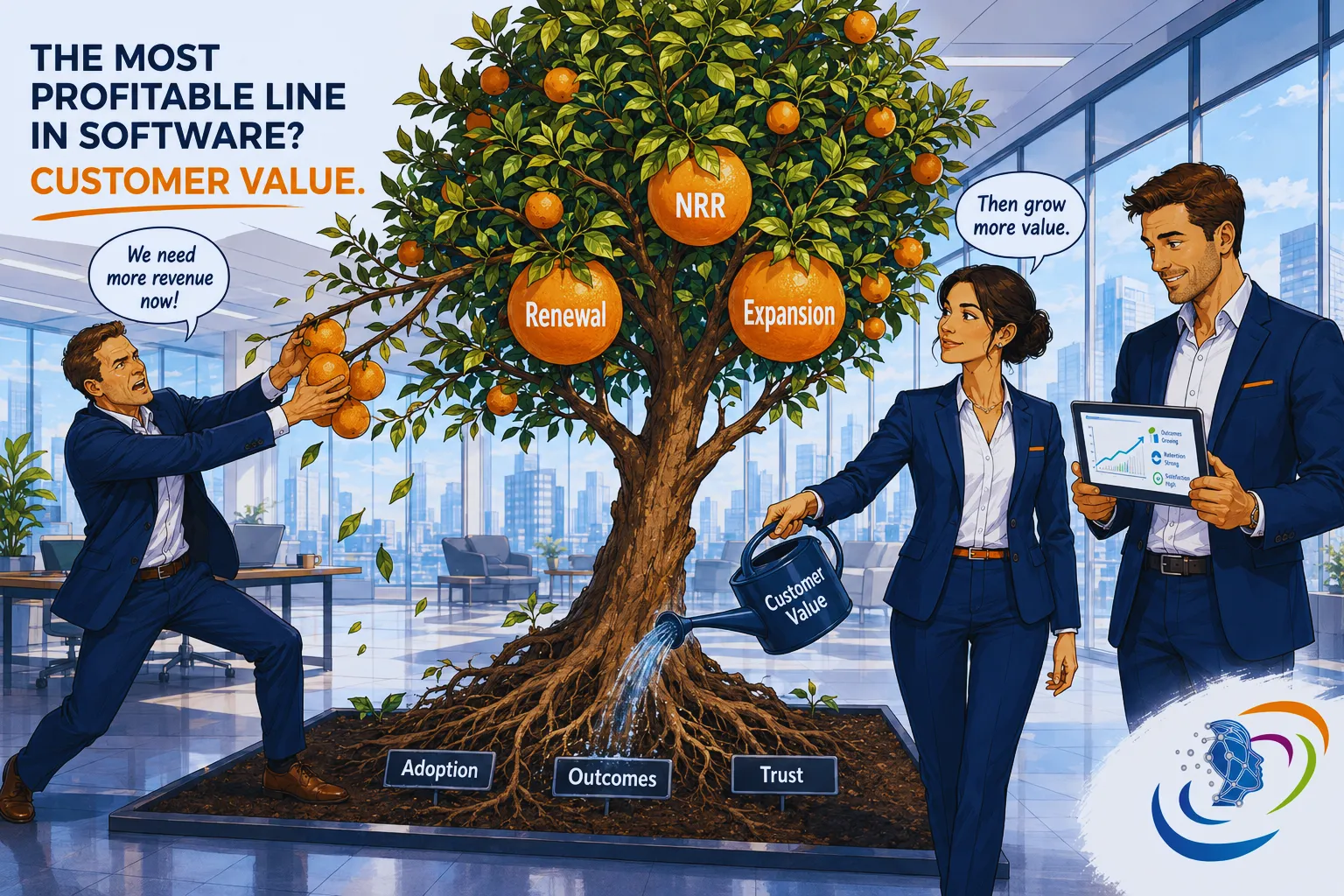
Here is the position I defend, after twenty years leading functions that live exactly on this line: the product of Customer Success is customer value. Revenue is the proof that the product worked. The sequence is not a philosophical flourish; it is the operating model. A CSM who opens with the customer's baseline, tracks outcomes every quarter, and arrives at the renewal with the customer's own numbers does not need to sell the expansion. The customer's CFO does it for them.
The AI-era CS function is not a relationship function with a dashboard. It is a value-instrumentation function: telemetry on adoption, baselines on business outcomes, AI-driven and digitally delivered for most of the base, human where the value conversation is complex. The customer success manager of 2027 will look less like an account manager and more like a value engineer with a portfolio.
Five moves for the board agenda
If I had to structure this for a software company's board this quarter, five moves.
- Run NRR like a P&L, not a KPI. Three buckets, three named owners: retention, pricing and discounting, expansion. Fewer than 20% of vendors have best-in-class practices in NRR management and reporting. Clear ownership is the cheapest 15-point lever on the market.
- Fund value realization as a discipline, not a slide. Baselines at onboarding, value reviews at every renewal and expansion moment, customer ROI in the customer's own numbers. It is worth 7 points of NRR and, more importantly, it is the raw material of every honest renewal.
- Design expansion into the product, not the quota. Upsell paths, cross-sell bundles, and in-product trials designed at the packaging level are worth 16 points. Renewal pressure is worth one cycle.
- Guarantee something. If 80% of buyers walk away without a performance guarantee, outcome commitments are coming to your category. Better to get there as the vendor that put a price on its own confidence than as the vendor that was forced to.
- Protect Customer Success's honesty. Measure CS first on leading indicators of customer value: adoption, time to value, outcome attainment. Let revenue be the lagging proof, and compensate the team accordingly. The day your CSMs are paid like salespeople is the day your customers treat them like salespeople.
The business, redefined
The software companies that win the next decade will not be the ones that extract the most from their installed base. They will be the ones whose customers can prove, in their own numbers, what the software was worth. Customer value is no longer the cost of doing business. It has become the business.
This article is adapted from edition #10 of my LinkedIn newsletter, Professional Services & Tech.
Subscribe on LinkedIn to receive future editions.
Sources:
McKinsey & Company, " The net revenue retention advantage: Driving success in B2B tech " (November 2025);
McKinsey & Company, " Introducing customer success 2.0: The new growth engine ";
ChurnZero, " Why is customer success still seen as less valuable than sales? " (August 2025).
Mathilde HENRY
Enterprise software and AI transformation executive. 20 years at the intersection of software, consulting, and organizational transformation.