






Start at the end: why services teams that do everything right are about to be paid for something else

Services organisations are built to do things right. The agentic era pays only for the right things. How to walk the chain backwards from the value the customer realises, protect margin and revenue on the way, and turn a team from doing it right to doing the right thing without losing the people.
In 2025, project margin across professional services reached 37.7%, a five-year high, according to SPI Research's 2026 benchmark of 509 organisations. In the same year, billable utilisation fell to 66.4%, the lowest in the nineteen years the study has run, and EBITDA averaged 9.9% against a five-year average of 13.8%.
Read those three numbers together. The industry has never delivered projects more correctly, and it has rarely earned less from it.
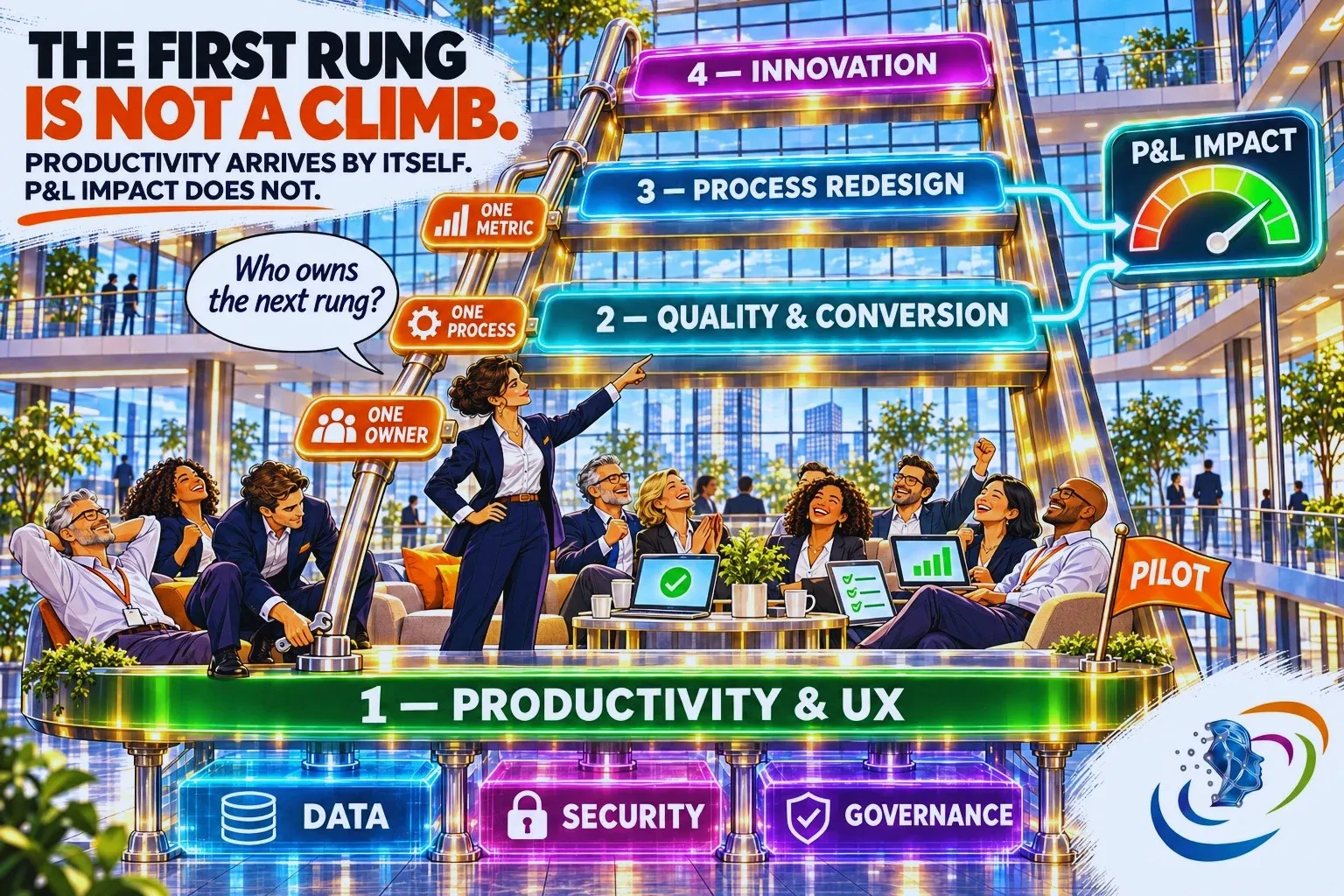
TSIA put a name on the cause this spring: a critical post-deployment value gap, where AI systems work and produce no measurable business outcome. The project was green. The customer was not different.
The question I ask in the first week
I have taken over services organisations three times, and each time I asked every director the same question in my first week: what did your last project change for the customer?
Every answer described what we had delivered. On time, on budget, tested, documented, signed off. Not one described what the customer did differently on the Monday after go-live. These were excellent teams. They had been built to do things right, and they did. Nobody had ever asked them to do the right thing.
Peter Drucker drew that line sixty years ago. Efficiency is doing things right. Effectiveness is doing the right things. Services has lived on the first half of the sentence for as long as it has sold days. The agentic era is about to pay only for the second.
The capital problem of services is not quality
The industry tells itself that services organisations lose ground on quality, cost or speed. Those are the things we are good at. The root problem is that the entire chain, from the deal to the go-live, measures whether the work was done right, and nothing in it measures whether the work was worth doing. Scope, time, budget, a green status report: all of it certifies execution. None of it certifies that a planner, a controller or a recruiter does their job differently because of us.
Consumption pricing turns that blind spot into a revenue event. When software ships agents priced on the tasks they complete, a customer who sees no value does not renegotiate. They switch the agent off. In that world, services is no longer a cost of selling the subscription. It is what keeps the subscription alive.
Start at the end: six links, walked backwards
The method I have used is simple to state and uncomfortable to run. Define the value the customer must have realised ninety days after go-live, then design every link of the chain backwards from it.
- The end. Before any statement of work: which KPI moves, which decisions the agent will take alone, which roles change. Written in the customer's words, signed by their sponsor and by our account team. If nobody can write that page, the project is not ready to be sold.
- The deal. Packaged scope wherever the work is repeatable, bespoke only where the value is. A sold margin with its assumptions on every project, owned by the project manager. The customer's own commitments in the contract: their experts, their data, their architecture decisions. At my former company, this is where the contribution margin went from negative to plus 8% in three years, in that order: pricing discipline first, delivery mix second, automation third.
- The team. One technical lead who owns the guardrails, what the agent may do alone and who approves the rest. One process lead who owns the redesign of the work around it. Salesforce has organised this as pods of one deployment strategist and two forward-deployed engineers, about three months per customer, and has committed to a thousand of them. TSIA describes the same move as forward-deployed engineering going from an elite profession to a scalable operating model.
- The delivery. The sold margin tracked monthly against the landing. Remaining days, never percent complete. Quality gates before go-live so that the first production run is right the first time. At my former company we generated the first design from the customer's context and took about 30% out of design time, and we generated test plans rather than writing them.
- The handover. Go-live is the beginning of the customer's journey, not the end of ours. Customer success in the room from the deal, one owner for the customer across services, support and success, and hypercare priced on what the agent achieves in its first ninety days, not on tickets closed.
- The measure. The page most services organisations never publish: expansion and renewal by who led the implementation, time to first value, roles changed. It is the only proof that the chain started from the right place.
From doing things right to doing the right thing
Here is the part that decides everything, and the part most transformation plans treat as a slide at the end.
You cannot tell a team that has spent ten years being praised for doing things right that it was the wrong thing. It was not. It was the job. So the turn has to be made with them, not to them. This is what I have done, three times.
I showed them the hours before I asked for anything. The product's own automation came first, design and tests, and the time appeared on calendars before the new expectations did. Nobody learns a new job on top of a full billable week, and nobody believes the time is coming until they can see it.
I gave everyone access, under guardrails, and let them build the change. All 500 people at my former company had the AI tools. We ran hackathons and championships, and workshops between R&D and delivery so that consultants understood what was behind the AI in the product. The ideas I ended up scaling came from consultants, not from me.
I rebuilt the skills matrix person by person, and gave each person a path: configurator, augmented consultant, outcome advisor or forward-deployed engineer. Not everyone makes it. I had those conversations myself, and I did not delegate them.
I changed what we celebrated. The monthly review opens with one customer story, what changed on their side, before anyone shows a margin.
I refused to measure AI adoption by usage. I have watched a company count tokens consumed as a performance indicator and lose its best engineers within two quarters. The only adoption metric that matters is what changed for a customer.
Through two transformations that included significant reductions, none of my direct reports left. I do not say that as a boast. I say it because it is the measure of whether a turn was made with people or to them. A team that is shown the time, trusted with the tools and told the truth about who will make it turns itself. A team that is told to adopt AI and measured on usage does what it has always done: things right, faster, and nothing else.
Revenue must flow from value
Finance will say that starting from value sounds fine until the quarter closes. Services revenue is recognised on delivery. Write the statement of work backwards from an outcome and you slow the deal, you leak margin on scope, and you hand sales an excuse to discount services.
I would reverse it. A statement of work written from the end is tighter, not looser: it carries acceptance criteria, customer commitments and assumptions that a day-rate contract never does. Packaged scopes with a sold margin sell faster and attach more often, because a buyer can understand them. And about ten years ago, at an engineering software vendor, I built a marketplace that priced engineering services on the outcome delivered rather than the days spent. Thirty partners joined in six months, and the business returned 30% on the capital employed.
Margin is the discipline. Revenue is the obligation. Value is where both come from now. TSIA's advice to treat forward-deployed investment as a cost of acquiring customers rather than a cost of goods sold says the same thing in accounting language: the services that produce value are not a cost of the subscription. They are how it gets renewed.
Five moves for the executive committee
If I were structuring this for a software company's services organisation this quarter, five moves.
- No statement of work without the end written first. The ninety-day value page, in the customer's words, signed by their sponsor and our account team, before pricing starts.
- One scorecard for the whole chain, one meeting. Deal, delivery, go-live, adoption, renewal, on the same page, with sales, services and customer success in the room. Margin is on it. It is not on top.
- Hours before expectations. Every consultant has a learning budget on the calendar, funded by the product's own automation, and a named path. If you cannot show someone the time, you have no right to ask for the change.
- Staff every agentic engagement with a pair. A technical lead for the guardrails and a process lead for the redesign, and the same pair through hypercare, so that the customer sees one team from the deal to adoption.
- Measure adoption by what changed for the customer, never by usage. Tokens consumed, prompts written and licences activated are activity. Decisions the agent takes without rework, and roles that changed, are results.
The chain, redefined
Stop asking whether your team does things right. It does. That is why you hired them, and it is what every dashboard you own confirms.
The real question is who in your chain owns what changes for the customer, and whether your people were given the time and the path to become that person. In most software companies the honest answer is nobody and no.
Start at the end. Walk the chain back. Bring the people with you.
This article is adapted from edition #[N] of my LinkedIn newsletter, Professional Services & Tech. Subscribe on LinkedIn to receive future editions.
Sources :
SPI Research, 2026 Professional Services Maturity Benchmark (19th edition);
TSIA, "Four Stages of Forward Deployed Engineering" (April 2026);
Salesforce, "Today's Hottest Role: Forward Deployed Engineer" (November 2025);
Peter Drucker, The Effective Executive (1967).
Mathilde HENRY
Executive Leader in Enterprise Software & AI Transformation. 20 years working at the intersection of software, consulting and business transformation.