
The denominator: why outcome-based contracts are decided long before anyone discusses price
Customers increasingly want to buy results rather than software. The hard part is not the pricing model. It is the baseline, the decision rights, and the question almost nobody asks a board: what does owning outcomes do to what your company is worth.
An executive put a question to me recently that I have not been able to put down since. If customers increasingly expect outcomes rather than software, does that change the business model over time? Today they largely buy software and services. Could they come to expect a vendor to take real ownership of a business result, and would that change how we package, price and deliver?
My short answer is yes, and sooner than most vendors are ready for. My longer answer is that the packaging question, which is the one everybody enjoys debating, is not the hard part. I have watched three of these deals up close, and none of the difficulty was in the pricing model
Three months arguing about a baseline
The first one taught me where the difficulty actually lives. We had agreed the principle in a morning: the customer would pay us against a reduction in a specific operational cost, and we would carry part of the risk. Everybody left the room energised. Then we spent the next three months arguing about the baseline.
Which sites counted. Whether a facility opened mid-year was in scope. What to do about the currency effect, the volume effect, the two acquisitions, the change in their own transfer pricing. Whether an improvement their team had already started could be attributed to us. Their finance director, entirely reasonably, wanted a baseline that excluded anything they would have achieved anyway. I wanted one that did not punish us for their bad quarter.
Both of us were right, and the deal nearly died over it. At one point our lawyer said the thing that has stayed with me: the entire commercial negotiation is about the denominator.
That is the first honest thing to say to anyone excited about outcome-based models. You cannot sell a result you cannot measure, and measurement is not a technical problem. It is a governance problem wearing a spreadsheet.
The capital problem of outcome models is not pricing
We tell ourselves the outcome problem is pricing creativity, or risk appetite, or that finance will not allow it. I no longer believe any of that. Those are symptoms.
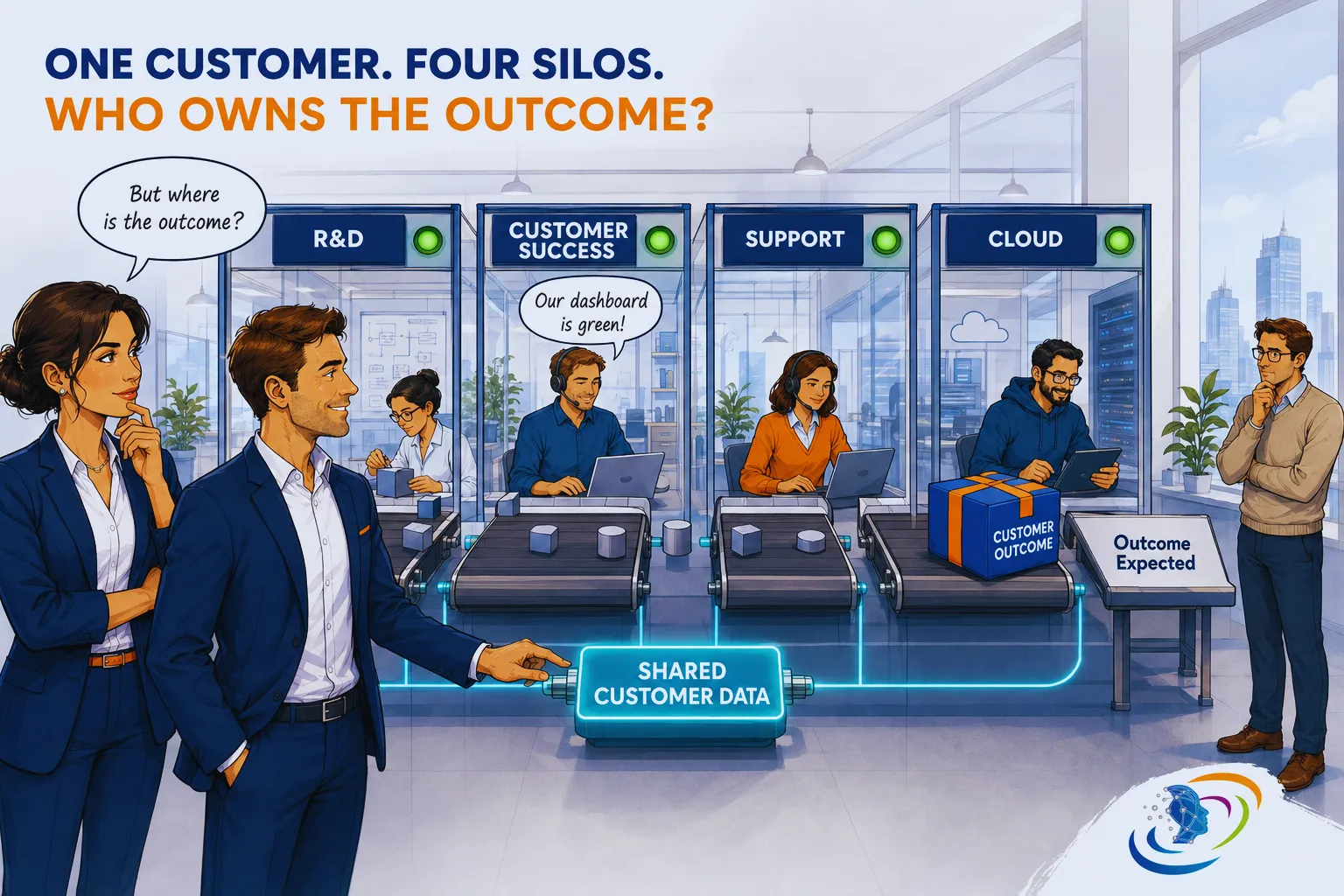
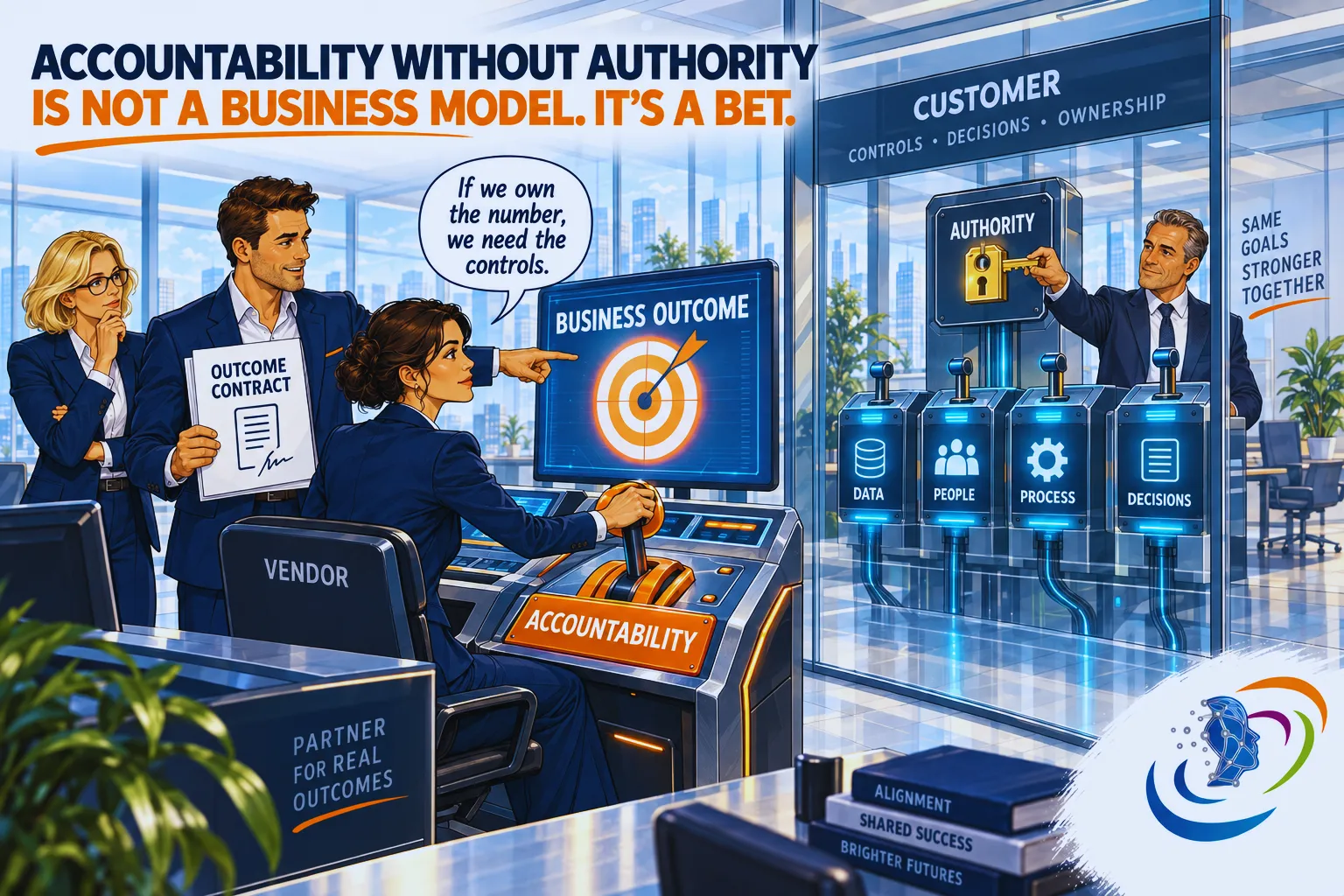
The root problem is accountability without authority. In a genuine outcome contract, a vendor accepts financial responsibility for a result produced by people it does not manage, in a process it cannot change, using data it does not own, inside an organisation whose priorities can be reset by an executive committee it does not attend.
Here is the asymmetry nobody prices in. When a vendor takes outcome risk, it transfers risk without transferring any of the control that would make the risk manageable. The customer keeps every decision right and hands over the consequences. Written that way, it is obvious that the price should be enormous. It usually is not, because vendors want the differentiation and are willing to pay for it with someone else's margin.
The contract I would not sign again
The second one is where I learned the cost of that trade. We hit the metric. We hit it because my team pushed decisions through, went around the planners who were slowing us down, and delivered the number the contract named. Everyone celebrated.
About fourteen months later, someone showed me the same metric, and it had drifted almost all the way back. The people who had to live with the new process had returned to the old one the week our team left.
We had been paid for the result and had produced nothing durable. Worse, we had spent the customer's internal goodwill to earn our own fee. A contract designed to align us had done the precise opposite: it had made the fastest path to our money the one that damaged their organisation.
That is the failure mode nobody writes into a gainshare mechanism, because it does not look like failure in the measurement window. It looks like success, invoiced on time.
We negotiate everything except the thing that matters
The governance page is the most valuable page in the contract and it is routinely treated as boilerplate. Outcome contracts are where that carelessness stops being survivable.
Look at what these negotiations actually consume: the gainshare percentage, the cap, the floor, the measurement window, the audit rights. Armies of lawyers on both sides, billing for months.
And the terms that decide whether the outcome is achievable at all are negotiated last, if at all. Decision rights. Data access. The authority to stop the customer doing something that will destroy the result. Sponsor availability. Who arbitrates when their organisation resists.
My opinion, and I hold it strongly: outcome ownership without decision rights is not a business model, it is a bet. Some of those bets pay. It is not a strategy for a company, and it is a very poor strategy for the delivery organisation that inherits it.
Three levels of outcome ownership, and only one of them is free
Most of the confusion in this debate comes from one word covering three different businesses.
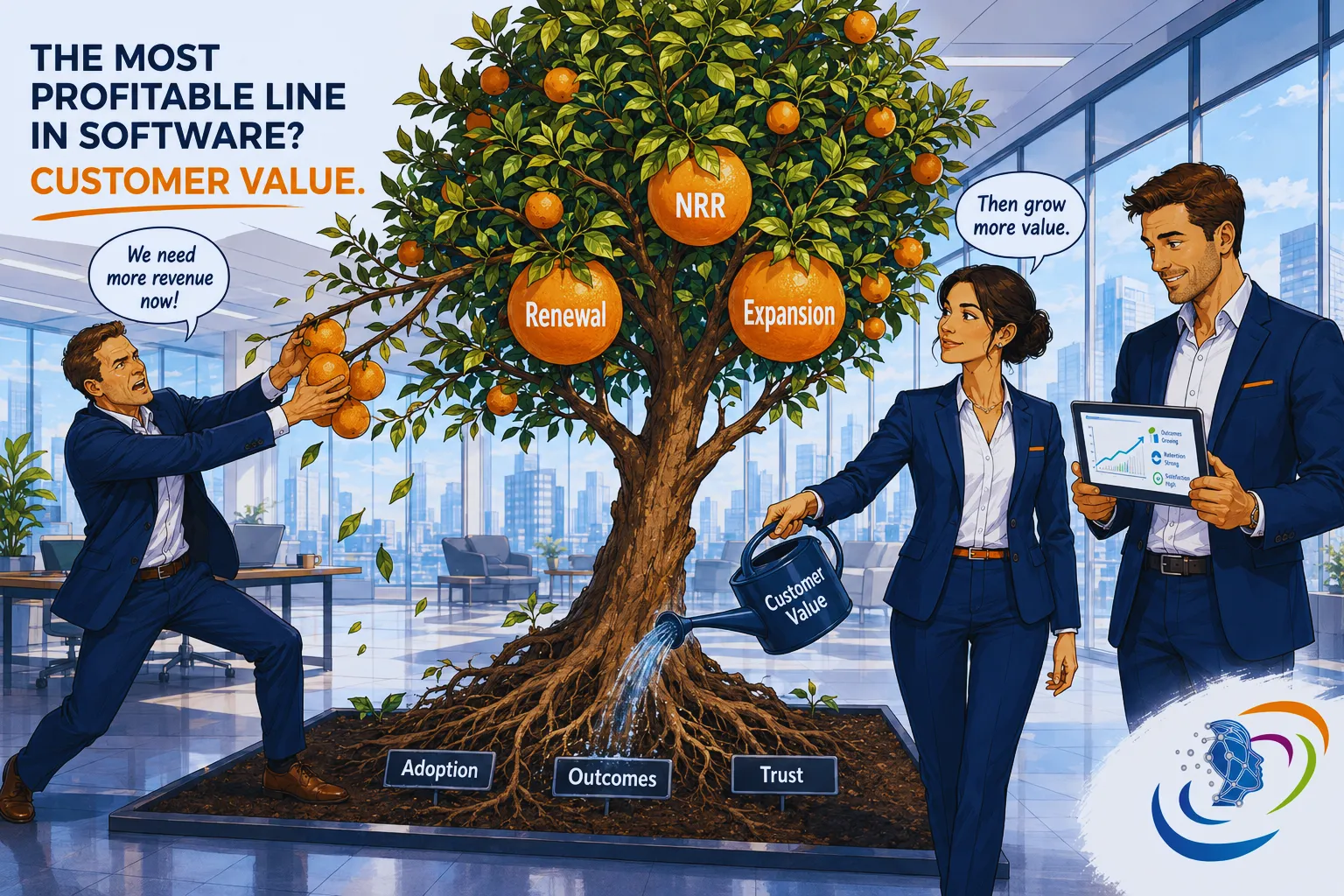
- Outcome-aligned. Pricing tied to things you already influence and can already see: consumption, adoption, time to value, usage of the modules that actually create the benefit. This is not really outcome pricing, and it is available to almost any vendor today. It is also the fastest way to change how customers experience you, because it moves the vendor's incentive from signature to use.
- [li]Outcome-shared. A gainshare on a business metric, with a jointly agreed baseline, joint governance, and both parties' obligations written down. This is real, it is demanding, and it works only where the vendor has enough authority to influence the result and enough discipline to walk away when it does not.
[/li]
- Outcome-owned. You run the process. You are accountable for the number the way an operator is accountable, because you are one. This is achievable, and several very good companies do it, but let us be precise about what it is: it is not a software business with a new price list. It is a business process operation with software inside it.
Almost everybody in enterprise software says outcomes and means the first. Customers, increasingly, hear the third. The gap between those two sentences is where the next five years of unprofitable contracts will be signed.
Three rules I ended up with
Never accept outcome risk without decision rights. If we are accountable for the number, we need the authority to change what produces it: named decision-makers, agreed response times, the right to escalate, and the right to declare a dependency breached when their side does not deliver. Contract our obligations and theirs on the same page, in the same detail.
Settle the denominator before the percentage. The baseline, the adjustment rules and the arbitration mechanism are the deal. If the two sides cannot agree how the result will be measured while everyone is still optimistic, they will certainly not agree once money depends on the answer. And a customer who will not agree a baseline is telling you something useful for free.
Only take outcome risk where sustainability is in the definition. If the metric can be hit in a way that leaves the customer's organisation worse off, that contract will eventually reward exactly that behaviour, whatever the intentions in the room. Measure at a point far enough out that the result has to survive the departure of your team.
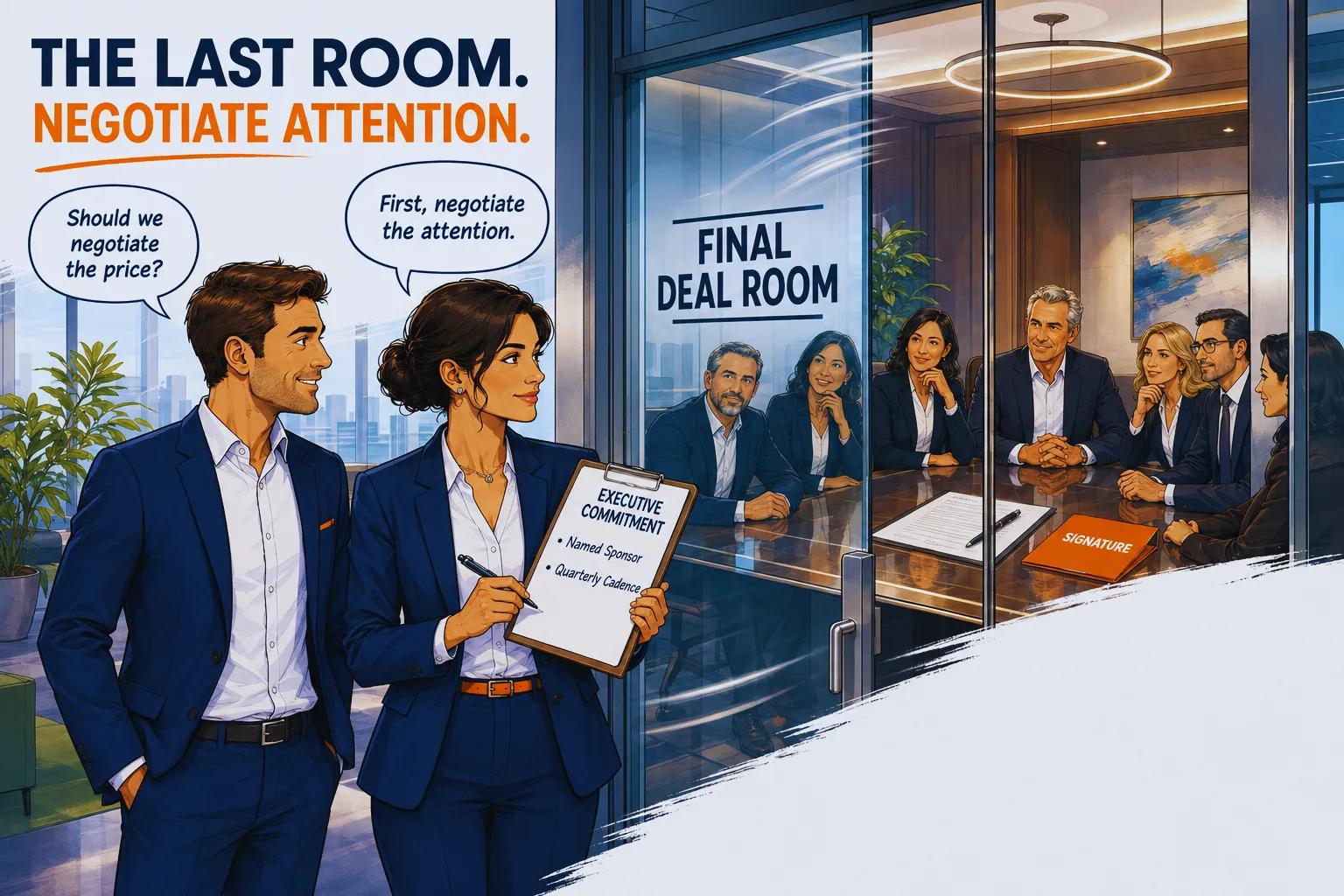
I have run services businesses on both models, in Europe, the Americas and Asia, and the pattern held everywhere. The outcome deals that worked were the ones where a named executive on the customer side had personally committed to the governance before signature. Every one that hurt us had a beautifully constructed commercial mechanism sitting on top of a sponsorship that evaporated by month four.
The objection, and why it is wrong
Sales leaders will say customers will never hand a vendor decision rights, and legal will never accept open-ended outcome exposure. Both objections are true, and both are arguments for discipline rather than against the model.
If a customer will not grant the authority, that is not a failed negotiation. That is a customer telling you, at no cost, that they want a supplier and not a partner. Sell them software and services, price it well, and deliver it excellently. There is nothing shameful about that sentence, and pretending otherwise is how vendors end up carrying operator risk on software margins.
What it does to what you are worth
There is a final consequence that rarely reaches the pricing discussion, and it is the one I would put in front of a board.
Moving toward outcomes pulls a software company toward operations. Operations means people, process ownership, and revenue that behaves less like a subscription and more like a service. The market pays very differently for those two currencies. A company can chase outcome contracts, win them, deliver them, and quietly convert itself into an operator that is capitalised like one.
Which turns the original question into a sharper one. Not how do we package outcomes. Rather: how much of our customers' operations are we willing to run, what authority will we require in exchange, and what does the answer do to the multiple we are managing the company for.
My own answer, for what it is worth, is that most enterprise software companies should go a long way into the first level, be extremely selective in the second, and enter the third only deliberately, with their eyes open and their investors informed.
The reframe
Customers are not really asking us to take their risk. They are asking us to stop pretending that handing over software was ever the same thing as delivering a result.
If you are being asked to price an outcome this quarter, try one exercise before the commercial discussion. Write down the baseline, the adjustment rules, and who decides when you disagree. If that takes more than an afternoon, you have found the real negotiation.
Take the accountability. Ask for the authority. And know which business you have just become.
Mathilde HENRY
Executive Leader in Enterprise Software & AI Transformation. 20 years working at the intersection of software, consulting and business transformation.