






The empty chair: why fixed-price projects lose their margin on the other side of the table
When a fixed-price project goes into the red, services teams look for the cause in their own estimate, their own staffing, their own project manager. In most of the cases I have lived, the cause was a customer expert who was meant to be in the room and was not. What a complete quote contains, why AI makes the missing chair more expensive, and the clause nobody wants to sign.
In 2025, fixed-price projects earned a project margin of 37.2% across professional services, slightly above the 36.4% of time and materials, according to SPI Research's 2026 benchmark of 509 organisations. The average project overran its budget by 10.7%. The best performers held that to 6.9%, against 12.1% for everyone else.
Read those numbers together and one conclusion follows. As an industry, we have become rather good at estimating our own effort. Fixed price is not the problem. What goes wrong on a fixed-price project usually goes wrong somewhere our estimate never looked.
The chair on the other side of the table
I was recently the guest of Aymeric de Ferrières of Stafiz for a webinar on how AI is changing the way services are sold, estimated and steered. Stafiz builds a professional services automation platform used by more than 400 services organisations, so Aymeric sees more project budgets in a month than most of us see in a career. We spent a good part of the conversation on estimation, and I said something more plainly than I ever had before.
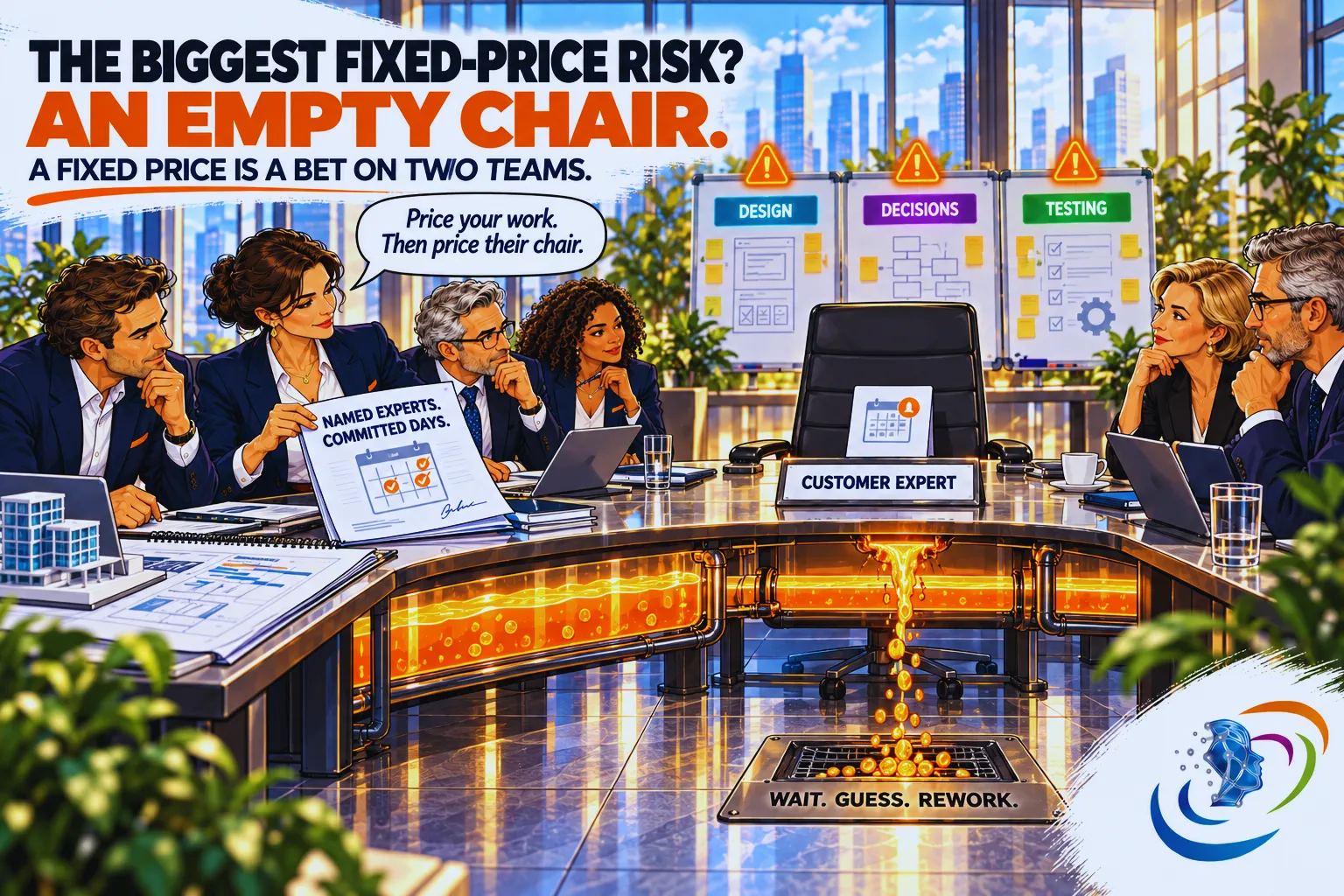
When a fixed-price project loses its margin, we look for the cause in our own team. The estimate was wrong, the staffing was wrong, the project manager was wrong. In most of the cases I have lived, the cause was a chair on the other side of the table: the customer's expert, the one person who knows how the business really works, who was meant to be in the design workshops and was not.
It is simply wrong to assume that a services team can deliver alone, with minimal participation from the customer. The customer is the one who knows their business, and the one who knows where the value is. If their experts are not available for the workshops, the design and the tests, no amount of talent on our side replaces them. We wait, we guess, we rework. That is where the margin goes.
The capital problem of fixed price is not estimation
The industry tells itself that fixed-price projects fail because we estimate badly. The data above says otherwise. The root problem is that a fixed price is a bet on two teams, and most quotes describe only one.
Aymeric's own figure makes the point from the other direction. Across Stafiz's customers, the average net project margin, once internal time, subcontracting and expenses are all counted, is close to 29%. The model works when the quote is complete. The margin disappears in the lines the quote left out.
Why AI makes the empty chair more expensive
You would expect AI to reduce the dependency on the customer's people. It does the opposite.
As more of the technical work is absorbed into the product itself, what is left for a services team is context: this customer's business, this customer's constraints, this customer's definition of value. AI does not standardise projects. It demands more contextualisation, not less, because the generic part is now free and only the specific part is worth paying for.
And context has exactly one source: the customer's own people. The more AI there is in the delivery, the more the margin depends on that chair being occupied.
What a complete quote contains
During the webinar, we reviewed what the most mature teams include in their cost budgets. The list is longer than most of the cost estimates I’m shown.
- The planned load, by phase and by profile.
- Subcontracting.
- Travel and expenses.
- The costs that cannot be re-invoiced.
- Any resale of licences.
- The delivery mode, on site or remote.
- The technical architecture and the environments.
- The real availability of the customer's teams.
Two of these deserve a word.
Expenses. Travel and costs are almost always badly handled at signature. The conditions for re-invoicing them are left vague, and the vagueness is paid for later, in margin. It takes twenty minutes in the negotiation to settle who pays for what, at what rate, with what ceiling, and it saves points of margin in delivery.
Architecture. I have seen projects fail, or lose their entire margin, because the environments were undersized or the technical architecture had been misjudged at the start. The architect is the one person who holds the whole design, technical and functional, in one head. I think we have underestimated that role in recent years, and we are paying for it.
The same discipline applies to outcome-based contracts. The market wants to move fast and skip the phase where both parties define the KPIs. That phase is where customer and provider agree on what success means. Cut it, and you have removed the one step that adapts the project to the use case.
The clause nobody wants to sign
Sales teams will tell you that a customer never signs a contract that commits their own people. Put that clause in, and you lose the deal to a competitor who left it out.
I would reverse it. If the customer's commitment is not in the contract, you have not sold a fixed price. You have sold time and materials in which you pay for the overrun. And a customer who will not commit their experts on paper is telling you, before signature, how the project is going to go. That is the cheapest moment to hear it.
In my experience, the customers who accept the clause are also the ones whose projects succeed, because the conversation forces them to free the people before the project starts.
Five moves for the executive committee
If I were structuring this for a services organisation this quarter, five moves, all of them before signature.
- Put the customer's calendar in the contract. Named experts, days per phase, for workshops, design and testing. And a written rule for what happens to the price and the date when those days are not provided.
- Assess the customer's maturity before you quote. The availability of their experts, how well they know their own processes, their ability to take part in design and tests. Make it a line in the risk matrix, with a contingency attached.
- Put an architect on the quote, not only on the project. Sizing the environments is part of pricing, not something to discover in month three.
- Settle expenses at signature. Who pays for what, at what rate, with what ceiling. The cheapest twenty minutes in the deal.
- Keep the KPI phase in outcome-based contracts. If both parties cannot write down what success means before the work starts, the contract is not outcome-based. It is a dispute scheduled for later.
The quote, redefined
Stop asking whether your team estimated its effort correctly. It probably did.
The real question is whether your quote describes both teams: the days you will spend, and the days they will give you. The second number is the one that decides the margin, and it is the one nobody writes down.
Price your work. Then price their chair.
This article is adapted from edition #[N] of my LinkedIn newsletter, Professional Services & Tech. Subscribe on LinkedIn to receive future editions.
Sources:
SPI Research, 2026 Professional Services Maturity Benchmark (19th edition);
Stafiz, figures from its customer base shared during the webinar of 8 October 2026 with Aymeric de Ferrières.
Mathilde HENRY
Executive Leader in Enterprise Software & AI Transformation. 20 years working at the intersection of software, consulting and business transformation.