

The unearned revenue: why outcome pricing is an operating model decision disguised as a pricing decision
Nearly every software CEO says seat-based pricing is on its way out. Almost none have replaced it. The gap is not about metering or customer readiness. It is about who inside the company earns the money, and when.
Ninety-seven percent. In April 2026, a Cruxy survey of three hundred SaaS CEOs found that 97% intend to retire seat-based pricing within two years. In the same market, pure outcome-based pricing is used by about 5% of companies that monetise AI according to High Alpha's 2026 benchmark, and by 3.8% of AI-agent companies according to Orb. Gartner, for its part, expects at least 40% of enterprise SaaS spend to shift toward usage, agent or outcome-based pricing by 2030.
Ninety-seven percent of intention. Under five percent of practice. That gap is usually explained as a metering problem, a maturity problem, or a customer readiness problem. I think the explanation is simpler and less comfortable. Almost every company announcing an outcome model is announcing a price change, and outcome pricing is not a price change. It is a change in who inside your company earns the revenue, and when.
A marketplace built ten years too early
About ten years ago, well before this vocabulary existed, I built a marketplace for engineering services priced on value rather than on days. Clients did not buy a number of engineers. They bought a defined industrial result, and the engineering firms delivering it shared the upside with the client when the result arrived. Shared revenue on one side, shared risk on the other, and nobody counting hours in between.
Commercially, it worked faster than anything I had sold before. Clients understood it in one meeting, which almost never happens with a services proposal, because for once the proposal was written in their language rather than ours. What nearly killed it had nothing to do with the market.
The first problem was the baseline. Every negotiation collapsed into an argument about what "before" had been. We were not negotiating the price. We were negotiating the denominator, and we discovered it after the commercial terms were agreed rather than before.
The second problem was attribution. When the result arrived, three functions on the client side had a legitimate claim to it, and at least one of them had not been in the room when we signed.
The third problem was the one nobody had modelled. Cash. In a value model, the services firm funds the delivery for months and collects at the end, if the result comes. Our revenue looked wonderful. Our cash looked like a startup's. The P&L said we were winning while the balance sheet said we were financing our clients, and no operating review we ran was designed to show both at once.
We fixed the first two with better contracting. The third was not a contracting problem. It was a business model problem, and I did not understand that at the time. Ten years later, the entire software industry is walking into the same three walls, at scale, and calling it a pricing strategy.
The capital problem of outcome pricing is not pricing
We tell ourselves the problem is measurement, or attribution systems, or customers who are not ready. Those are symptoms.
The root problem is when the revenue is earned. Under a licence or a seat, revenue is decided in the deal room and recognised on paper. The company that sells is the company that earns. Under a consumption or outcome model, almost nothing is earned at signature. Revenue is manufactured every week, in production, by the people most software companies still classify as cost.
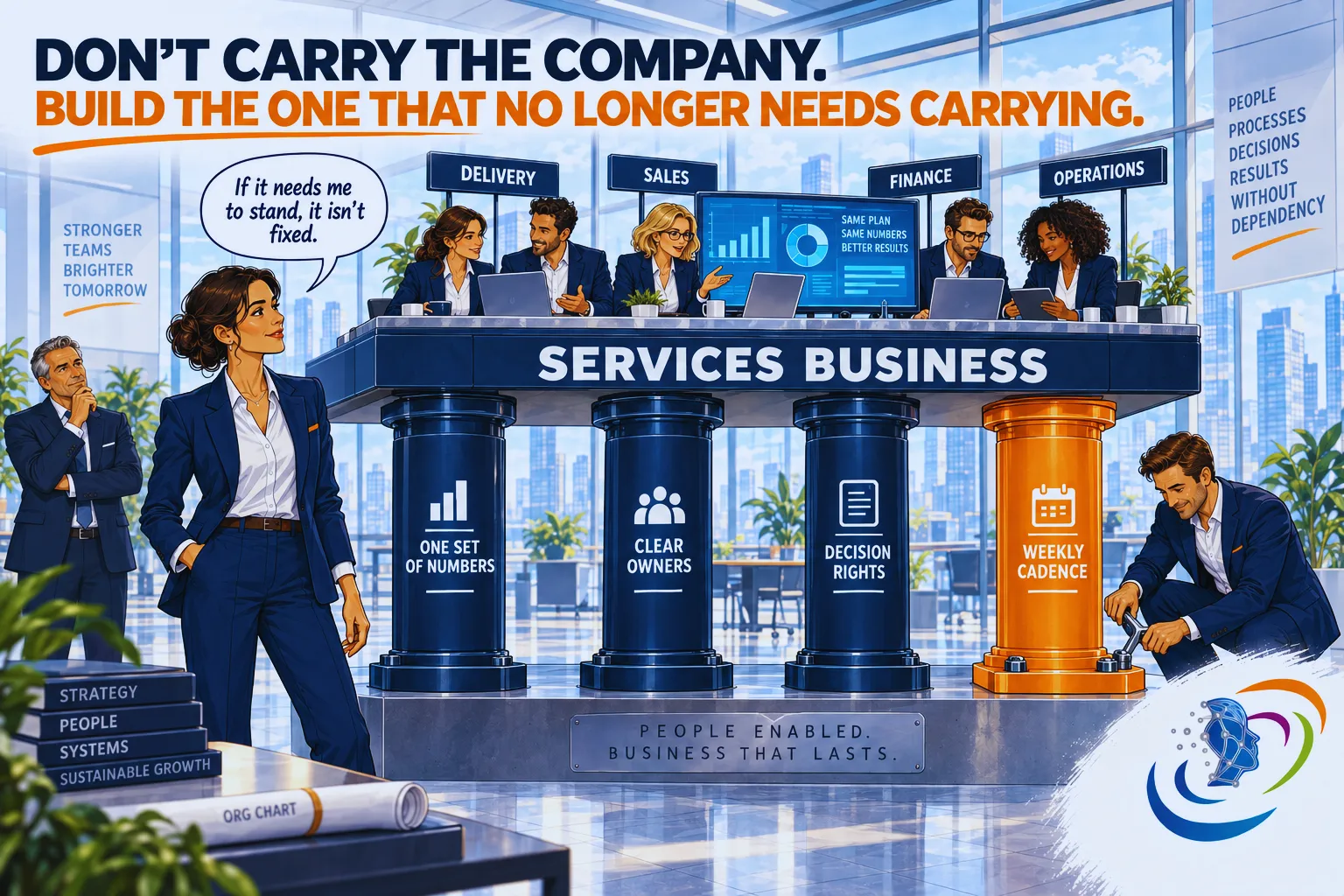
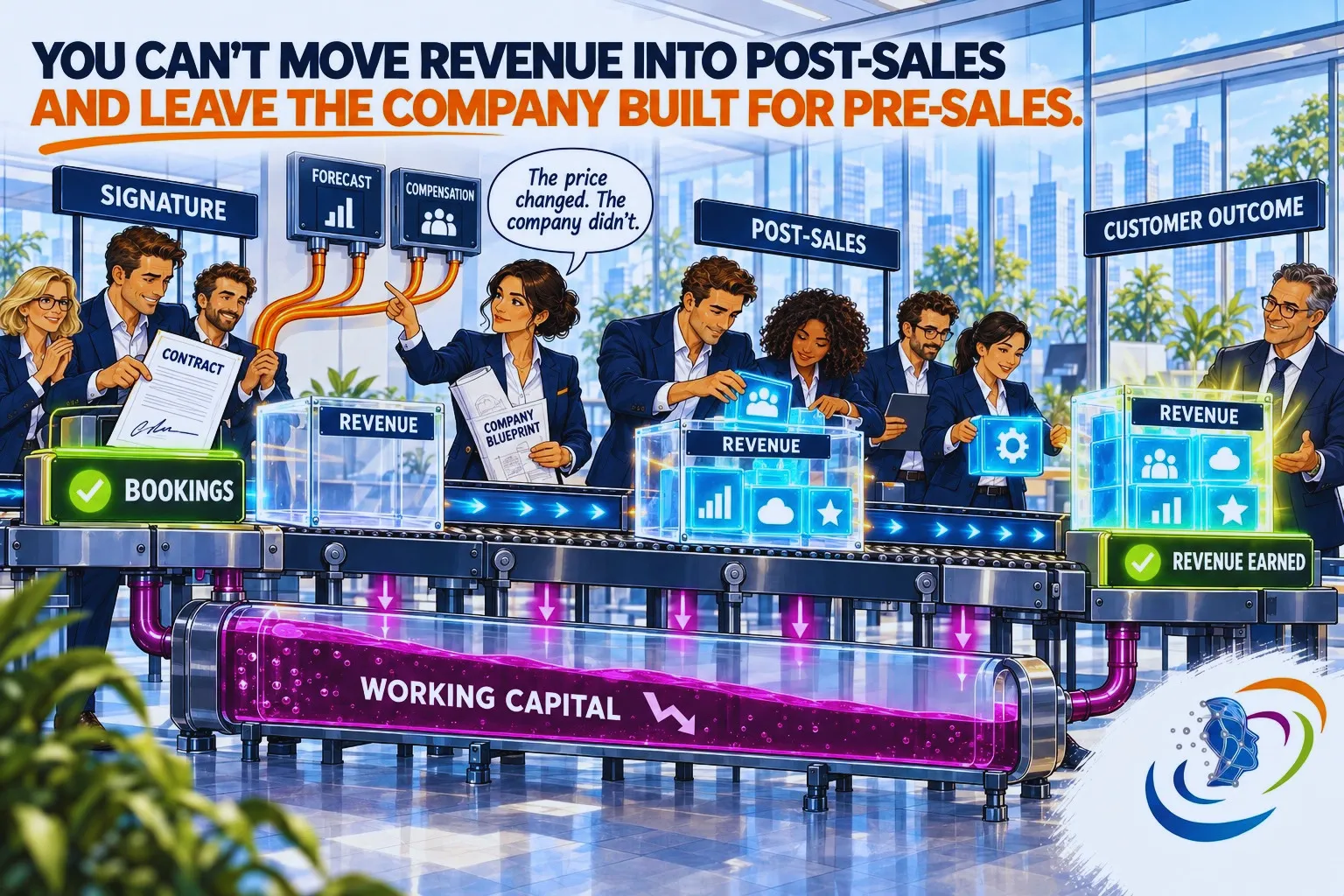
That is the sentence the industry keeps skipping. You cannot move your revenue into post-sales and leave your company built for pre-sales.
When you move to outcome, you do not just change how the customer pays. You take the customer's execution risk onto your own balance sheet, and you do it with a sales compensation plan that still pays at signature, a forecast built on bookings, and a delivery organisation with no seat at the table where revenue is discussed.
We reprice everything except the company
Look at what gets redesigned when a software company announces an outcome model: the rate card, the metering infrastructure, the packaging, the contract template. And the three things that decide whether the model survives, the cash curve, the compensation plan and the decision rights of the delivery organisation, are usually redesigned by no one.
The data confirms the pattern. Zylo's 2026 survey found that 78% of IT leaders had encountered unexpected charges linked to consumption or AI features. That is not a metering failure. It is what happens when a vendor changes how it is paid without changing how it governs what it delivers. The customer discovers the new model on the invoice, exactly as the vendor discovers it on the cash flow statement.
Predictability is not what it seems
The objection is predictable. CFOs and boards will say that consumption and outcome models destroy predictability, and that predictability is what the market pays a multiple for.
I would reverse it. The predictability of a seat-based contract is the predictability of a number that has stopped describing the customer's reality. It tells you what the customer committed to two years ago, not what they are getting today, and it holds its shape right up until the renewal conversation where it does not. You are not choosing between predictable and unpredictable revenue. You are choosing between revenue you can watch being earned every week, and revenue you discover has gone at renewal.
Consumption models are volatile because they are honest. That volatility is not new risk appearing. It is existing risk becoming visible, which is the only condition under which anyone can manage it.
Five moves for the executive committee before the pricing committee meets
- Model the cash curve before the revenue curve. For any outcome or consumption model, quantify the working capital it consumes in year one and who is funding it, before looking at the growth it produces in year three. Boards approve outcome models on the revenue slide and discover them on the cash slide.
- Agree the baseline before the commercial terms, never after. In an outcome model, the baseline is the product. Whoever writes it owns the economics of the contract for its full duration. Put it in the term sheet, not in the statement of work.
- Price only what can be metered without an argument. If the result cannot be read in a system both sides can see, price the output that produces it and say so plainly. An outcome you will spend two years litigating is worse than an output you can invoice.
- Move compensation to where revenue is now earned. A sales plan that pays in full at signature under a consumption model pays for a promise the company has not yet kept. Split the incentive between signature and realised consumption, and put delivery leadership on the same metric.
- Give the delivery organisation a seat where revenue is forecast. Under an outcome model, the forecast is a delivery forecast. If the people who manufacture the revenue every week are not in the room where it is predicted, the forecast will be wrong in a direction the board will not enjoy.
The pricing model, redefined
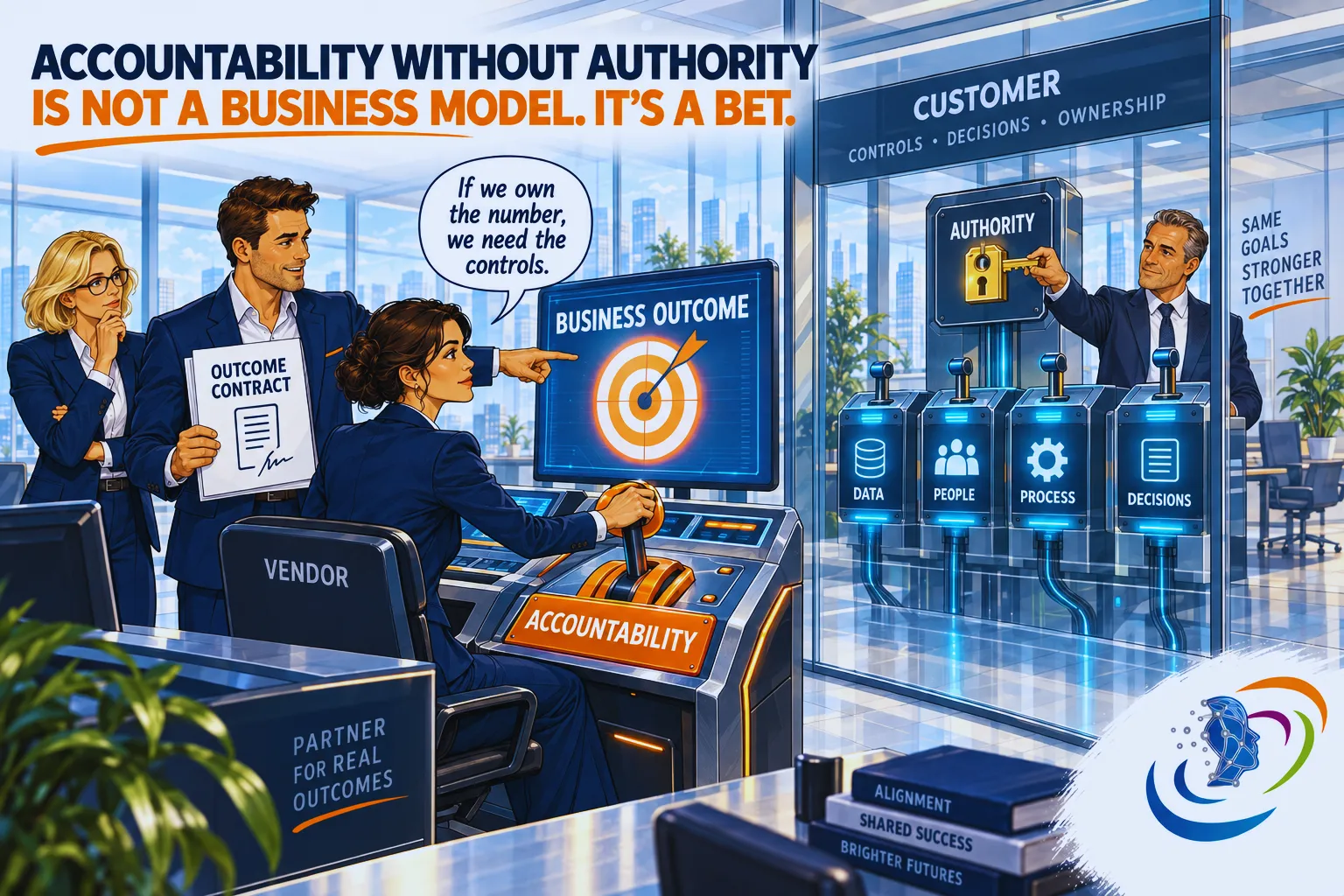
Stop treating outcome pricing as a pricing decision. It is an operating model decision that arrives disguised as a pricing decision, and it gets approved by the people who are not going to have to deliver it.
The question is not which model you announce. It is whether your company can survive being paid the way you just promised to be paid.
I learned that ten years early, on a small scale, with my own cash. The industry is about to learn it at scale, on the quarterly earnings call. Announce the model second. Rebuild the company that can carry it first.
This article is adapted from edition #[N] of my LinkedIn newsletter, Professional Services & Tech. Subscribe on LinkedIn to receive future editions.
Sources:
Cruxy, survey of 300 SaaS CEOs on pricing intentions, April 2026, cited by Userpilot, "What's the endgame for SaaS pricing models", August 2026;
High Alpha, 2026 SaaS Benchmarks analysis of AI monetisation models (53% subscription, 31% hybrid, 11% usage, 5% outcome);
Orb, "SaaS pricing statistics" and 2026 study of AI-agent pricing, August 2026;
Kyle Poyar, State of B2B Monetization survey, 2026 edition (230+ software companies);
Gartner, forecast on enterprise SaaS spend shifting to usage, agent or outcome-based pricing by 2030, cited in Deloitte TMT Predictions 2026;
Zylo, 2026 SaaS Management survey on unexpected consumption and AI charges.
Mathilde HENRY Executive Leader in Enterprise Software & AI Transformation. 20 years working at the intersection of software, consulting and business transformation.