




The faster consultant: why AI in Professional Services is stuck at the first of seven models
Services firms have never been better equipped with AI, and their utilisation has never been lower. Where the saved hours are going, the seven ways to do AI in Professional Services, and who collects the gain in each.
In 2025, billable utilisation across professional services fell to 66.4%. That is the lowest level in the nineteen years SPI Research has run its benchmark, drawn this year from 509 organisations, and it came with an average EBITDA of 9.9%.
Now put that figure next to two others from the same period. Wipro says SAP's AI assistant for consultants saves each of its people 90 minutes a day, which it puts at more than seven million hours a year. McKinsey's global managing partner, Bob Sternfels, describes his firm as 40,000 humans and 20,000 agents, up from 3,000 agents eighteen months earlier.
Read those numbers together. The profession has never been better equipped, and its utilisation has never been lower. The hours are being saved. They are not arriving anywhere.
The question I could not answer
Two years ago, in a previous role, I presented our AI programme to an executive committee. I was proud of it. 1,400 consultants equipped. 82% weekly usage. Six hours saved per consultant per week, measured, not estimated. On paper, close to 400,000 hours a year.
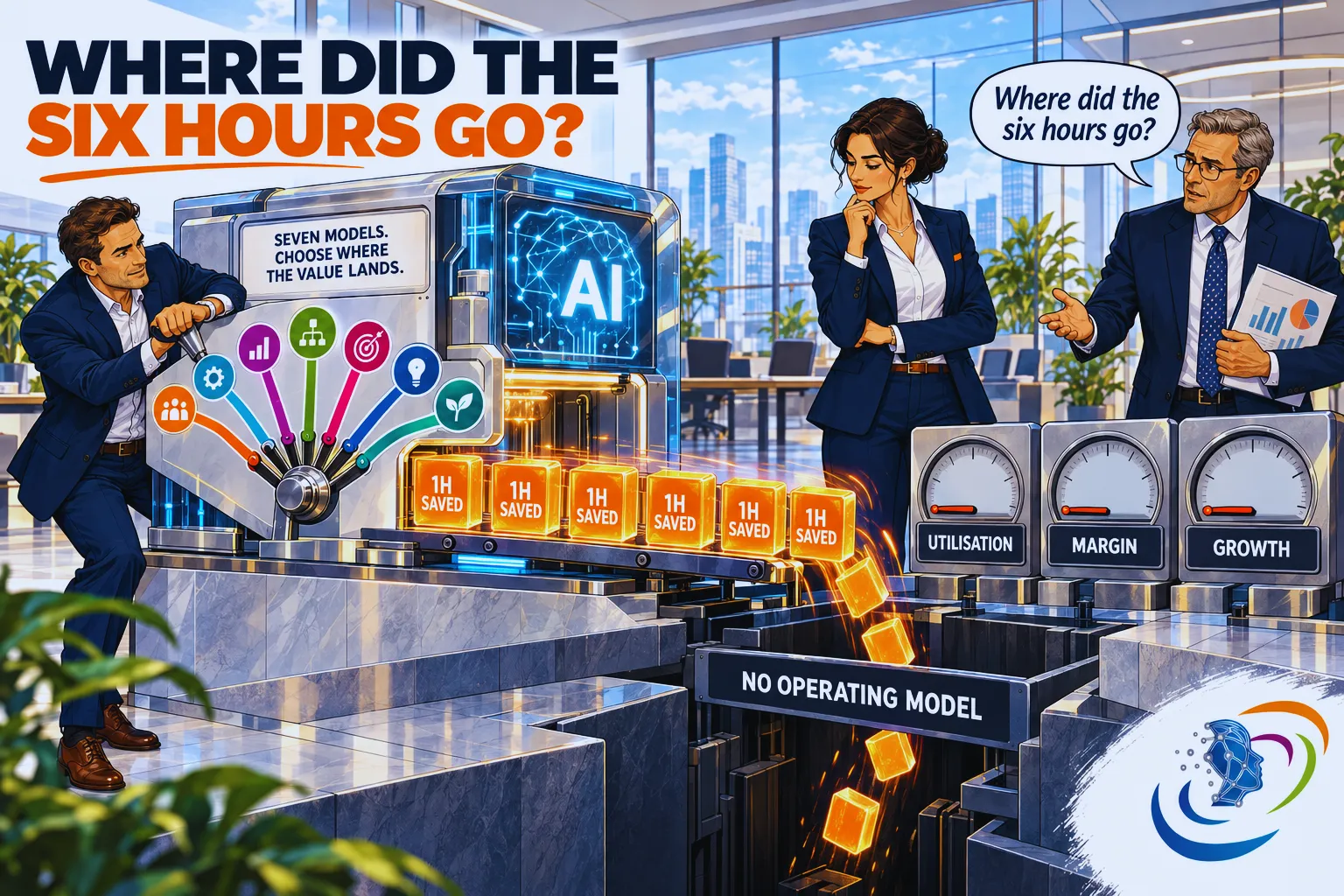
The CFO let me finish, then asked: "Where did the six hours go?"
I did not have an answer. Utilisation had not moved. Project margin had not moved. Delivery times had not moved. We had not sold one additional project with the capacity. The hours had dissolved into slightly better documents and slightly earlier evenings. We had bought a faster consultant and changed nothing about what a consultant was for.
The capital problem of AI in services is not productivity
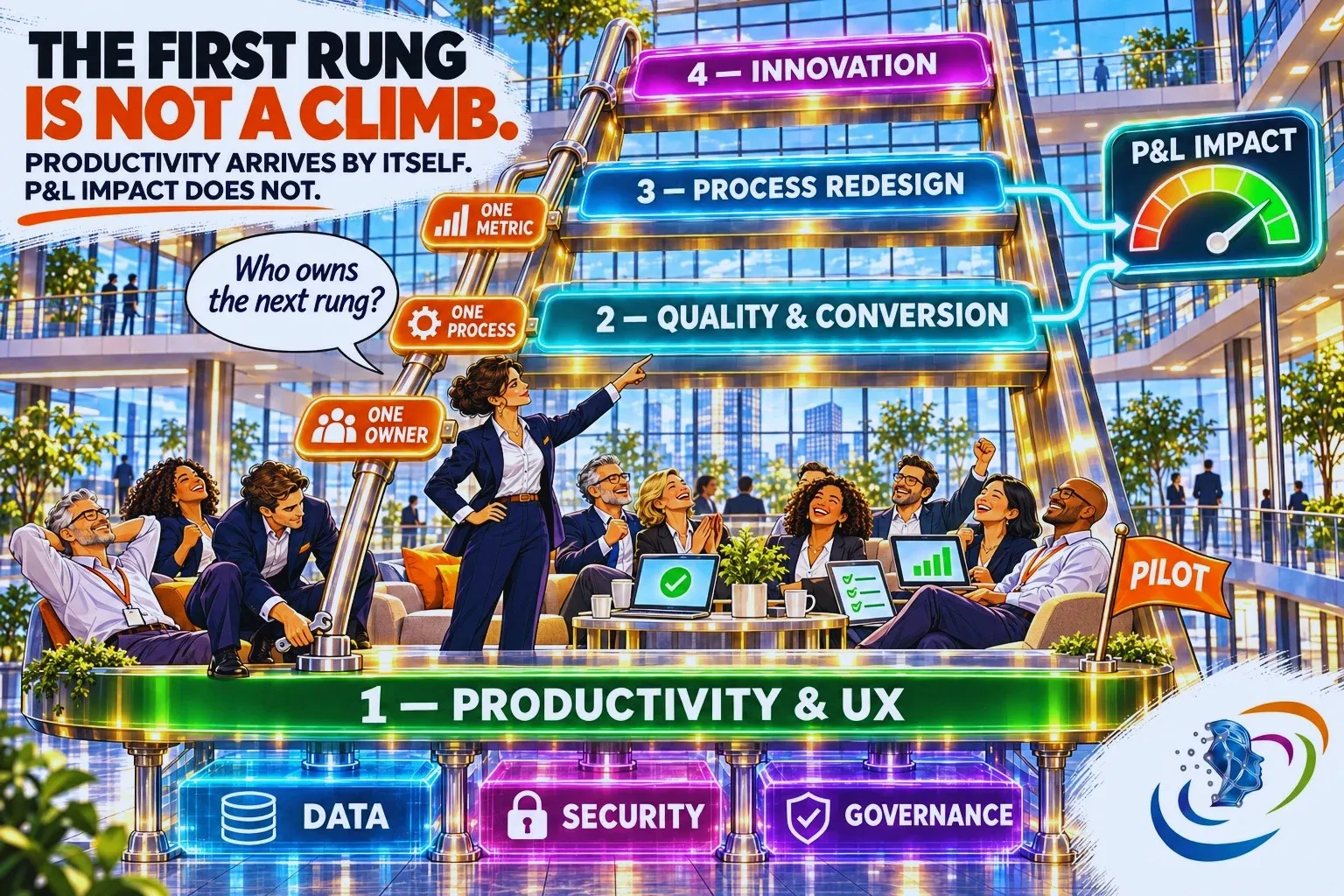
The industry tells itself the problem is adoption, or tooling, or the skills of its consultants. Those are symptoms. The root problem is destination. Every hour AI saves has to land somewhere: in your margin, in your client's price, in new capacity, or nowhere. Most programmes never decide, so the hour lands nowhere.
And if you do not decide, your client will. Earlier this year the Financial Times reported that KPMG pushed its own auditor, Grant Thornton, to lower its fee on the grounds that AI should make the audit cheaper. The fee went from 416,000 to 357,000 dollars, a cut of about 14%. One of the Big Four, asking a peer for an AI discount. Every procurement team in the world read that story.
Seven ways to do AI in Professional Services
When a services leader says "we are doing AI", they almost always mean the first item on this list. There are at least seven, and what separates them is not the technology. It is where the saved hour ends up.
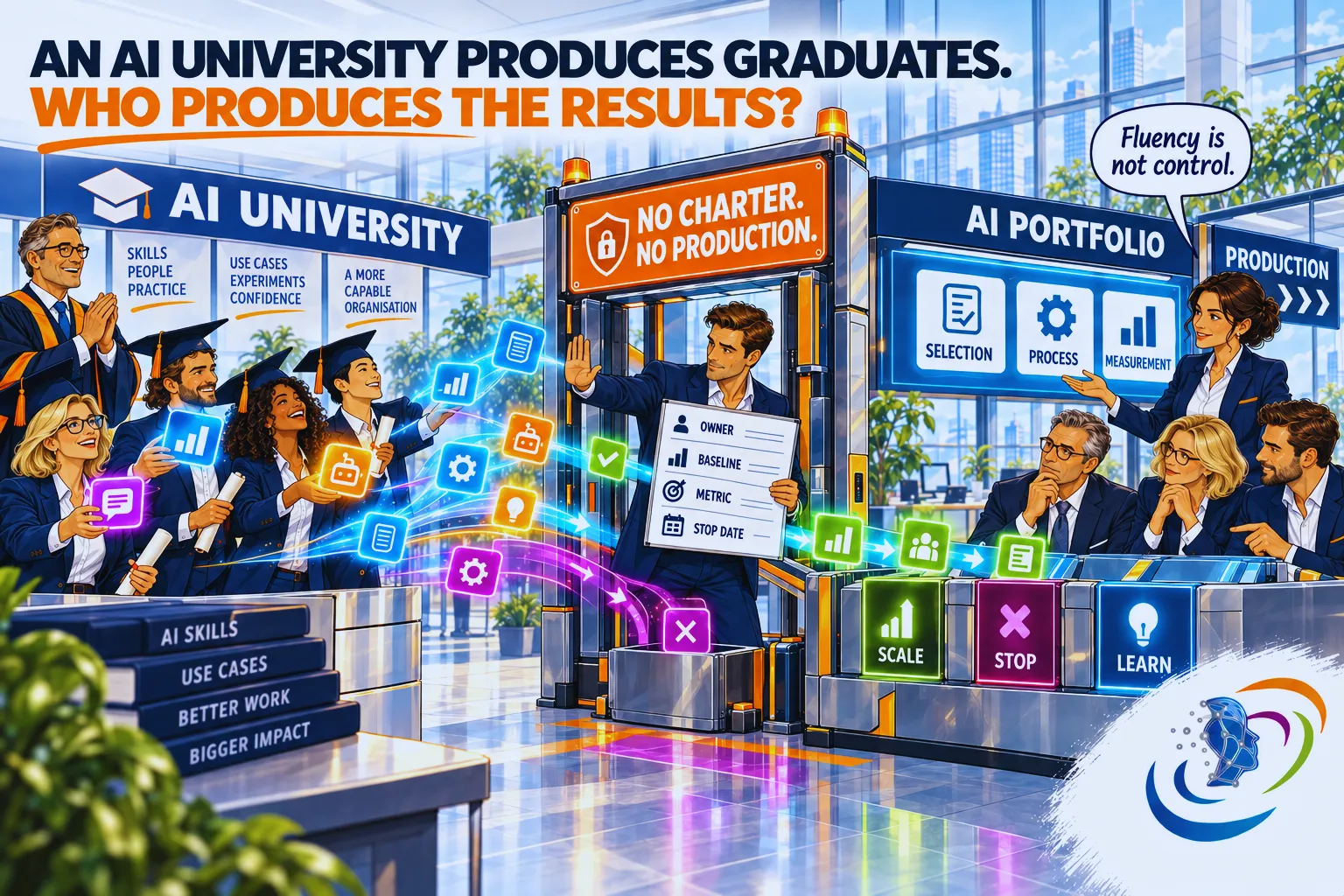
- The assisted consultant. Every consultant gets a copilot. In the Harvard and BCG experiment on 758 consultants, those using AI worked 25% faster and produced work rated 40% higher in quality on tasks the model handles well. Where the hours go: nowhere, unless something else changes. This is hygiene, not strategy.
- The delivery factory. AI does the work instead of assisting the person doing it: migrations, upgrades, test generation, data mapping. Amazon cut the upgrade of a Java application from 50 developer-days to a few hours, and Andy Jassy put the total at 4,500 developer-years saved. In a previous role, my team rebuilt a data migration workstream around a mapping engine we owned. Eleven weeks became nine days, and because we sold it at a fixed price, the margin on that workstream went from 28% to 61%. Where the hours go: to whoever wrote the contract.
- The agent on the roster. Agents are staffed like people, with a role, a scope and a reviewer. That is what McKinsey's 20,000 means. Where the hours go: into the shape of the team, which becomes smaller and more senior.
- The instrumented PSO. AI pointed at the business of services itself: forecast, remaining work, scope drift. In a previous role I had an agent read every status report, timesheet and ticket in the portfolio and tell me each Monday which projects were not telling the truth. In its first quarter it flagged nine projects reported green. Seven were red within sixty days, and write-offs fell by more than a third that year. Where the hours go: straight to margin, and no client ever negotiates them away.
- The forward-deployed model. Engineers embedded with the customer, building on real data, feeding what they learn back into the product. Where the hours go: into the sale. Delivery becomes the proof.
- The priced outcome. You sell the result, with an agent doing the delivery. Fin, the company formerly called Intercom, charges 99 cents for each customer problem its agent resolves and nothing when it fails. In June, Salesforce agreed to buy it for about 3.6 billion dollars. Where the hours go: they stop existing as a unit.
- The AI-native services firm. Build the firm around the AI, or buy a traditional one and rebuild it. General Catalyst has committed 1.5 billion dollars to this, after mapping 70 categories of services and finding 10 where 30 to 70% of the work can be automated today. Where the hours go: to the owner of the firm, which is why the owners are changing.
Services became the go-to-market
For twenty years we were told that services were the low-margin cost of selling software. The fastest-growing AI companies in the world have just reversed that.
Palantir reorganised its commercial motion around bootcamps that deliver working workflows on customer data in five days or less, where its pilots used to take one to three months. It told investors about a utility that signed a seven-figure deal five days after attending one. I ran my own version once: we replaced a six-week paid discovery phase with a four-day build on the customer's data, and conversion to a full programme went from one in three to two in three.
The market has noticed. Job postings for forward deployed engineers on Indeed rose by more than 700% in a year. In May, OpenAI and Anthropic each announced a services company built with private equity partners, within hours of each other, and OpenAI's was valued at 10 billion dollars. The two organisations with the most advanced models in the world looked at why enterprise AI stalls and concluded that what they were missing was a services firm.
MIT's research explains why. 95% of enterprise generative AI pilots show no measurable return, and projects run with an external partner reach deployment about twice as often as those built alone. The scarce resource in AI is no longer the model. It is the last mile, and the last mile is what Professional Services has always done.
What none of the seven automates
Look at what the seven automate: research, drafting, code, tests, forecasts, conversations. The one thing a client pays a services firm for, someone who knows where the model is wrong on this terrain and who will answer for it, is automated by none of them.
The same Harvard and BCG study that measured the 40% gain measured the other side. On a task just outside the model's competence, consultants using AI were 19 points less likely to reach the right answer. In 2025, Deloitte Australia delivered a report to the Australian government, for 440,000 Australian dollars, containing references to academic papers that do not exist and a fabricated quote from a court judgment. The firm later disclosed that a generative AI model had been used and agreed to refund part of the fee.
The durable asset of a services organisation is therefore its record of where AI fails. Which data shapes break the migration engine. Which contract clauses the agent misreads. Which customer contexts make the forecast lie. I call it the failure corpus. It is the only thing in the seven ways that a competitor cannot buy, and almost nobody is writing it down.
Five moves for the executive committee
If I were structuring this for a services organisation this quarter, five moves.
- Give every saved hour a destination before you save it. Margin, price, capacity or apprenticeship. Write it into the business case and have finance review it. No destination, no rollout.
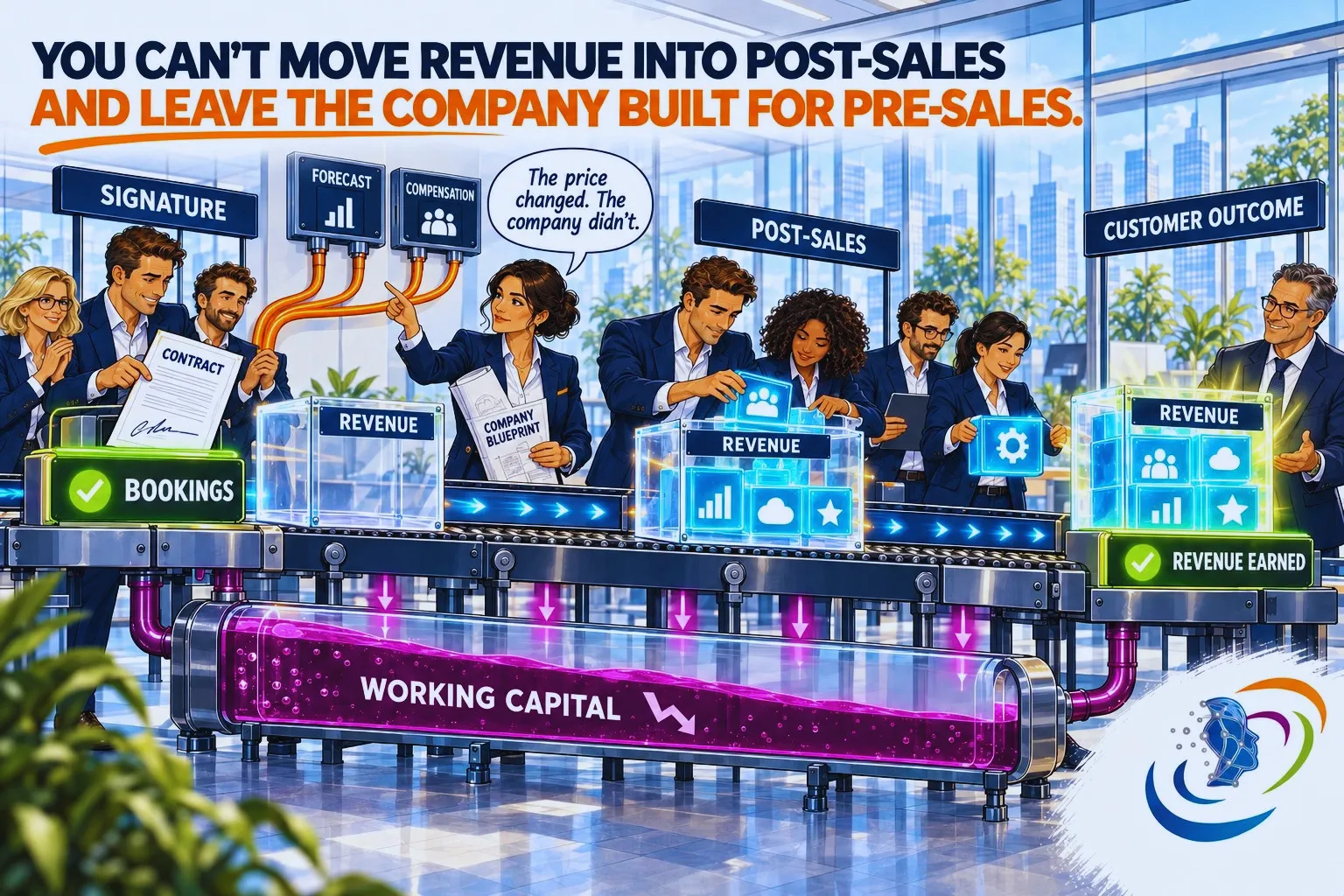
- Change the contract before you change the tooling. Automating work that is sold on time and materials automates your own revenue. Move the workstreams you intend to automate to a fixed price or a named asset first, then automate them.
- Staff the work, not the people. For each type of engagement, list what no human should do again. Give agents a line in the staffing plan, and a named reviewer who answers for what they produce.
- Point AI at your own P&L before your client's. Forecast, remaining work, scope drift. It is the least visible use of the seven and the only gain nobody outside the firm can claim.
- Keep the failure log. Every time the AI was wrong on a client's terrain, record it, review it and reuse it on the next project. It is the most valuable document in the organisation and the cheapest to produce.
Going slowly to protect the rate card is the one move that is not on this list. It does not protect the rate card. It hands the last mile to someone better funded.
The faster consultant, redefined
Stop asking how AI can make your consultants faster. A faster consultant is the least interesting thing this technology can do for you, and the only one of the seven your client can claim back with a single email.
The real question is which of the seven you are running, and who collects. AI did not make Professional Services obsolete. It made it the scarcest capability in enterprise technology, and everyone with capital has noticed. Decide where the hours go, before someone else does.
This article is adapted from edition #[N] of my LinkedIn newsletter, Professional Services & Tech. Subscribe on LinkedIn to receive future editions.
Sources:
SPI Research, 2026 Professional Services Maturity Benchmark (19th edition);
SAP, customer story on Wipro and SAP Joule for Consultants (2025);
Fortune, on Bob Sternfels and McKinsey's 20,000 agents (January 2026);
Financial Times, on KPMG and Grant Thornton audit fees (February 2026);
Dell'Acqua et al., "Navigating the Jagged Technological Frontier," Harvard Business School working paper 24-013 (2023);
Andy Jassy, statement on Amazon Q and Java upgrades (August 2024);
Palantir Technologies, earnings calls Q3 2023 and Q1 2024;
Indeed job postings data on forward deployed engineers, reported by Business Insider (2026);
Salesforce, "Salesforce Signs Definitive Agreement to Acquire Fin" (June 15, 2026);
General Catalyst, "The Future of Services," and TechCrunch (September 2025);
Associated Press, on Deloitte Australia's partial refund (October 2025);
TechCrunch, on the OpenAI and Anthropic enterprise services ventures (May 4, 2026);
MIT Project NANDA, "The GenAI Divide: State of AI in Business 2025."
Mathilde HENRY
Executive Leader in Enterprise Software & AI Transformation. 20 years working at the intersection of software, consulting and business transformation.