





The ungraded university: why in-house AI changes what professional services is for
Customers are building AI universities and taking work in-house. The knowledge gap that services firms sold for decades is closing, and the mandate that replaces it is selection, process and proof.
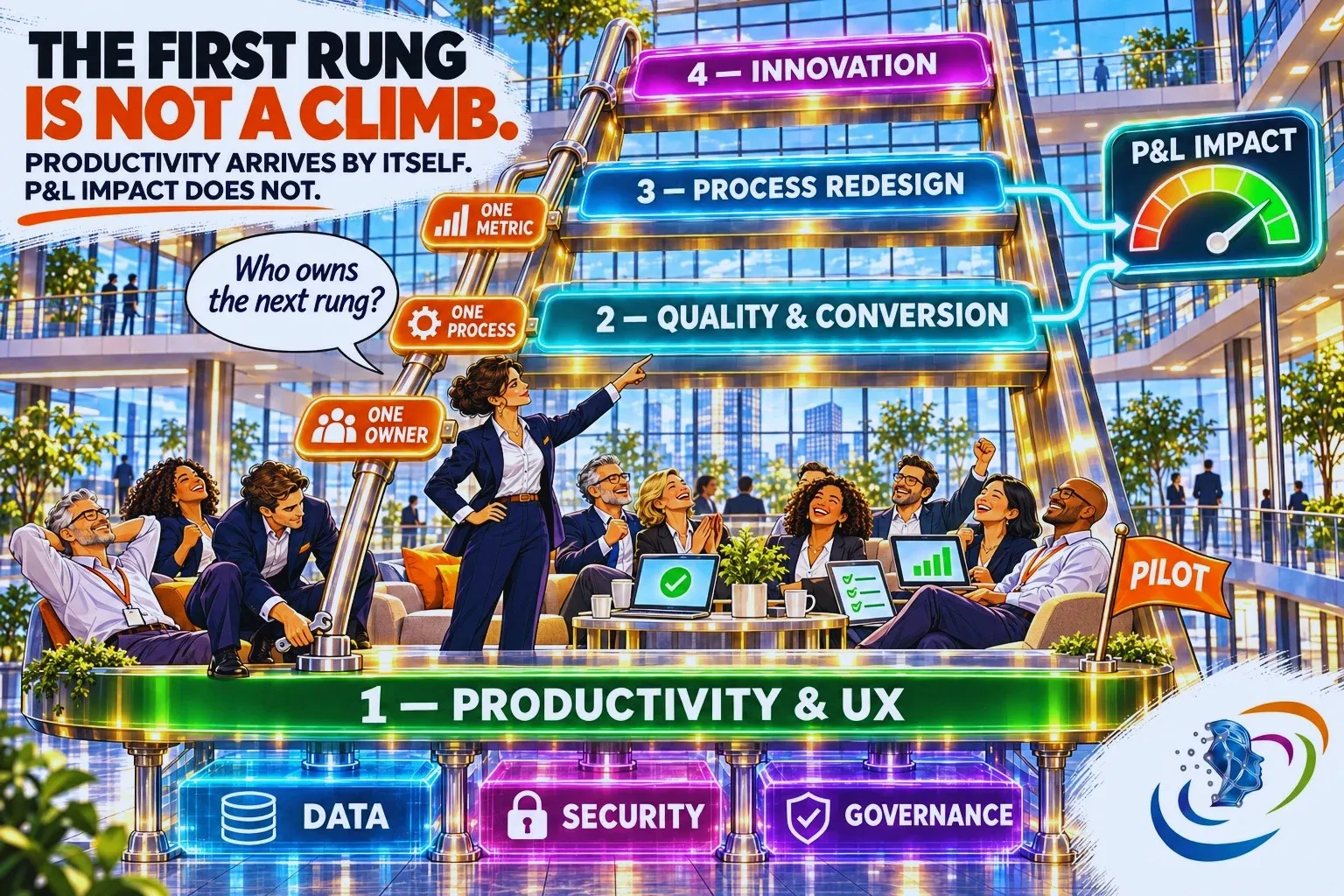
Large companies plan to invest $186 million in AI, on average, over the next twelve months. Only 11% of them are scaling it across functions. The figures come from KPMG's first Global AI Pulse, a survey of 2,110 senior leaders in 20 countries. They describe a market that has decided to spend before it has decided how to measure.
A second number completes the picture. In General Assembly's State of Tech Talent 2026, 83% of talent leaders say their company's success now depends more on upskilling employees for AI than on hiring. In the same survey, 43% say they struggle to measure the benefits of that training.
Put the two together and a pattern appears. Companies are investing heavily, they are training their own people instead of waiting for outside expertise, and a large share of them cannot yet say what the training produces. This article is about what that pattern means for the firms that used to sell the expertise, and for the executives who buy it.
The customer has become fluent
Companies no longer wait for vendors and consultants to explain AI to them. They build their own academies, sometimes real universities with professors and a curriculum, and they set one ambition: a working knowledge of AI for every employee.
They are right to do it. KPMG finds that organisations scaling AI alongside workforce investment are nearly four times more likely to report meaningful business value (77% against 20%). It also changes the economics of professional services:
- Teams that used to be taught now prompt, build and challenge the consultant's design choices.
- The first version of a use case, once a billable project, is increasingly built in-house.
- The knowledge gap between vendor and customer, which justified a large share of services revenue, is closing.
The services hours that are leaving
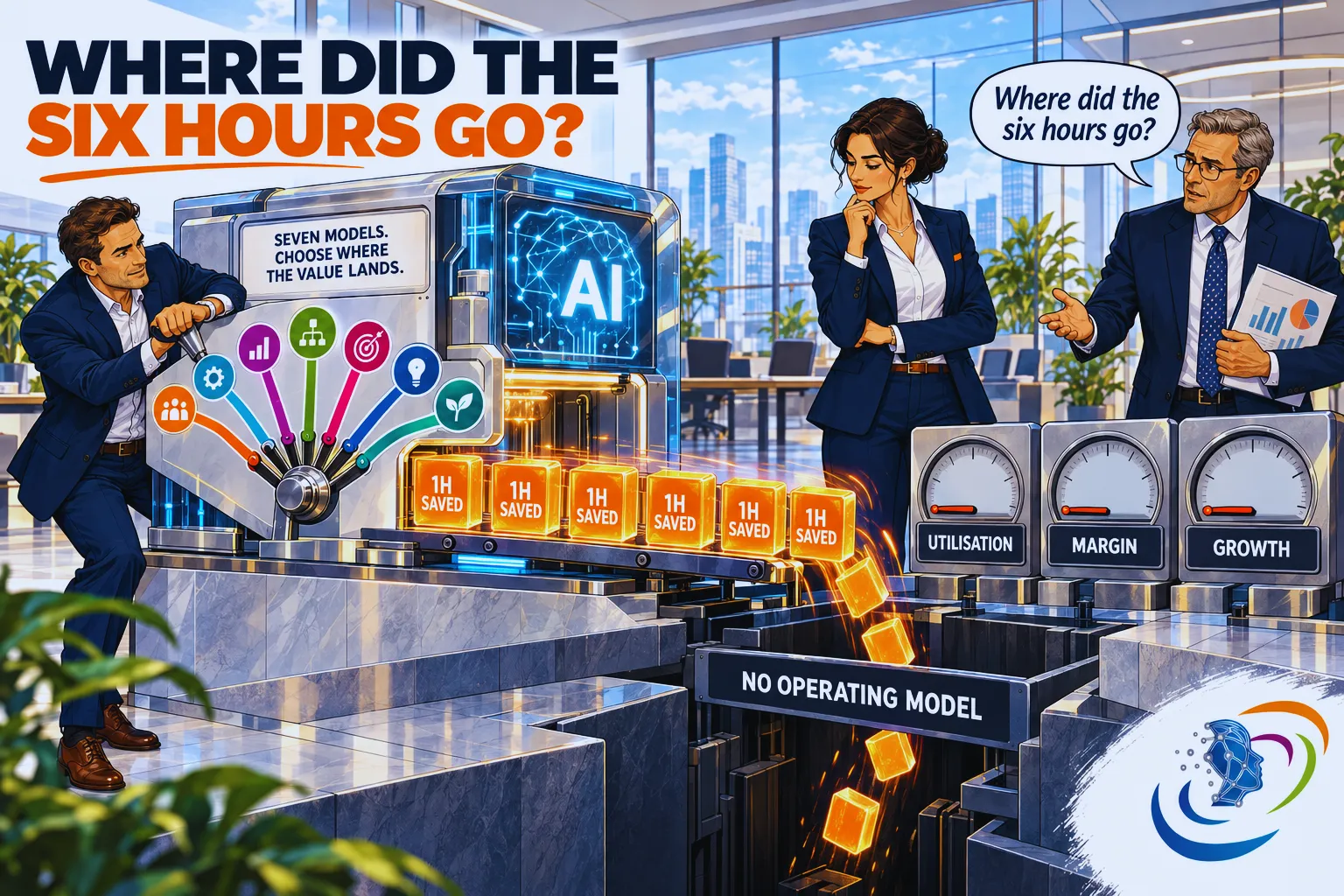
The Financial Times reported in August 2026 that companies of every size are asking for lower fees or taking work in-house, helped by AI tools and by software that needs less integration. Source Global still expects clients to spend $420 billion on technology consultants this year, 8% more than in 2025, but $236 billion of that is implementation work, the category most exposed.
This reaches well beyond consulting firms. Every software vendor with a services organisation built part of its revenue on the same hours: discovery workshops, configuration, the first build, training. When the customer can do most of that alone, the services line shrinks unless it changes what it sells.
The honest reading for a services leader is simple. The hours billed to explain, to configure and to build a first version are leaving, and they are not coming back. Defending them is defending a forecast.
Fluency is not control
A client recently described their AI university to me with pride, and then with worry. The approach, for now, is to teach everyone and see what comes out of it. Try and fail. Nobody measures the outputs yet. The fear was not that people would fail to learn. The fear was losing control.
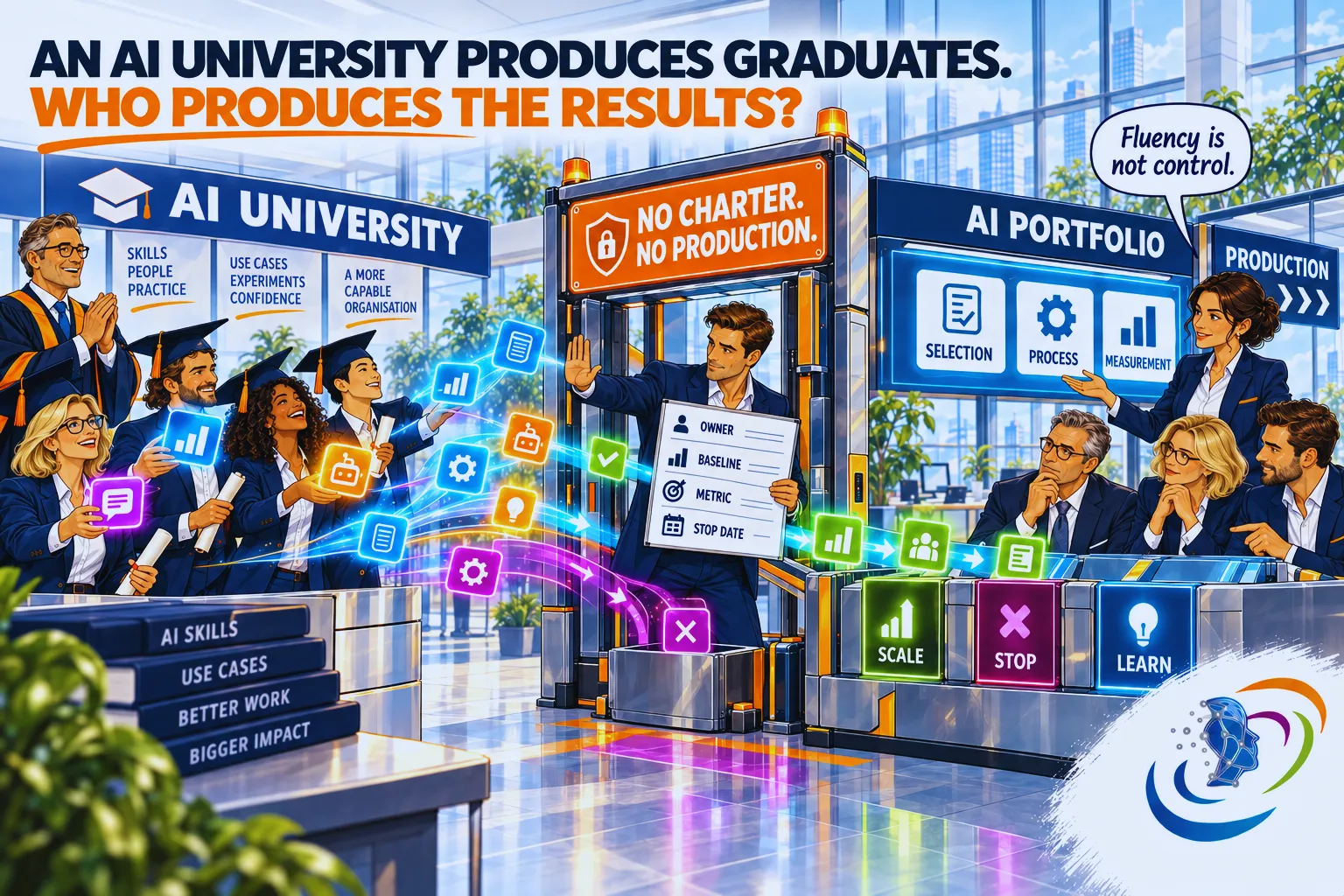
The university is right, and so is the fear. A university produces graduates. It does not produce a portfolio. A thousand newly fluent employees start a thousand local experiments, and together those experiments are:
- changes to how the company runs that no one chose,
- priorities that no one ranked,
- results that no one can audit.
Literacy was the easy part to buy. Control has to be built.
Why "teach everyone and see" is not yet a strategy
Try and fail is a sound way to learn. It becomes a risk when nobody writes down what was tried, what failed and what it cost. Unmanaged experimentation has four costs that rarely appear in the business case for the academy :
- Duplication. Several teams solve the same problem separately, each with its own tool and its own data extract.
- Shadow processes. A report, a forecast or an approval step is quietly automated, and the documented process no longer describes how the work is done.
- Unvalidated decisions. A model nobody tested adjusts a number somebody else relies on.
- Lost learning. Lost learning. A failed experiment teaches the person who ran it, and nobody else.
None of these is an argument against the university. Each is an argument for attaching a second mechanism to it, one that selects, tracks and measures what the graduates build.
What cannot be taken in-house
For decades, professional services sold a knowledge gap: the vendor knew the product and the method, the customer did not. The university closes that gap, and it should. Three things remain that a classroom does not provide:
- Selection. An internal team sees its own company, a services team sees many. The same use case can succeed in one company and stall in the next for reasons that have nothing to do with the model. Choosing the ten ideas worth funding out of two hundred is a judgment built on comparison.
- Process. A use case is a change to a process, with an owner, an exception path, a data dependency and a point where a human decides. A course teaches the tool. It does not redesign replenishment or pricing around it.
- Measurement. A baseline taken before the work starts, a metric the CFO accepts, and a date on which the use case is scaled or stopped.
The gap has moved from knowledge to judgment and proof.
None of this is owed to services firms. Only one in three clients told Source Global that an IT transformation overseen by external advisers was wholly successful. The mandate goes to the teams that bring evidence from comparable deployments and accept being measured on the customer's scoreboard.
Five moves for the executive committee
1. Name one owner for the use case portfolio. The dean of the university owns learning. An executive with a P&L owns results.2. Require a one-page charter for each use case. No charter, no access to production data.
3. Make the graduation project a real use case. With a baseline, so that the university feeds the portfolio instead of running beside it.
4. Keep try and fail, and add a ledger. What was tried, what failed, what it cost, what was learned, reviewed every quarter with the CFO in the room.
5. Buy services on the metric, not on the hours. Ask external partners to define use cases and processes with your teams, and tie part of their fee to the result written in the charter.
What a one-page charter contains
- The process it changes, and the executive who owns that process.
- The baseline: the current value of the metric, measured before the work starts.
- The target, in a unit the CFO accepts.
- The data it depends on, and who maintains that data.
- The point at which a human decides, and what happens to exceptions.
- The date on which the use case is scaled or stopped.
If a team cannot fill the page, the use case is not ready for production. If it can, the experiment has become a commitment.
What this changes for services leaders
The temptation is to defend the old model and to argue that customers will fail alone and come back. Some will. It is not a strategy. The firms that keep a seat at the table will be the ones that change what they sell:
- From teaching the tool to selecting the use cases worth building.
- From building the first version to designing the process around it.
- From days delivered to results measured, with part of the fee tied to the customer's metric.
- From frameworks to evidence drawn from comparable deployments.
Teach everyone, then grade the work
The usual objection is that measurement kills experimentation. The opposite is closer to the truth. A one-page charter takes an hour to write. What ends a programme is the meeting, a year in, where the CFO asks what the university has changed and nobody can answer.
An AI university should not be managed as a training programme. It is a change to how the whole company works, and it deserves a scoreboard as much as a syllabus. The question for the board is not how many people have been trained. It is what changed in the business because they were.
For customers, the university is the best news of the year. It is bad news only for the services firms that were selling the syllabus.
This article is adapted from the latest edition of my LinkedIn newsletter, Professional Services & Tech.
Sources :
KPMG, Global AI Pulse Q1 2026
General Assembly, State of Tech Talent 2026
Financial Times, "Consultants head for a showdown with their own clients as AI upends industry", August 2026, via The Irish Times
Forrester, 2026 technology and security predictions
Mathilde HENRY, Executive Leader in Enterprise Software & AI Transformation. 20 years working at the intersection of software, consulting and business transformation.