

The last silo: why the AI era forces software vendors to rebuild around customer value
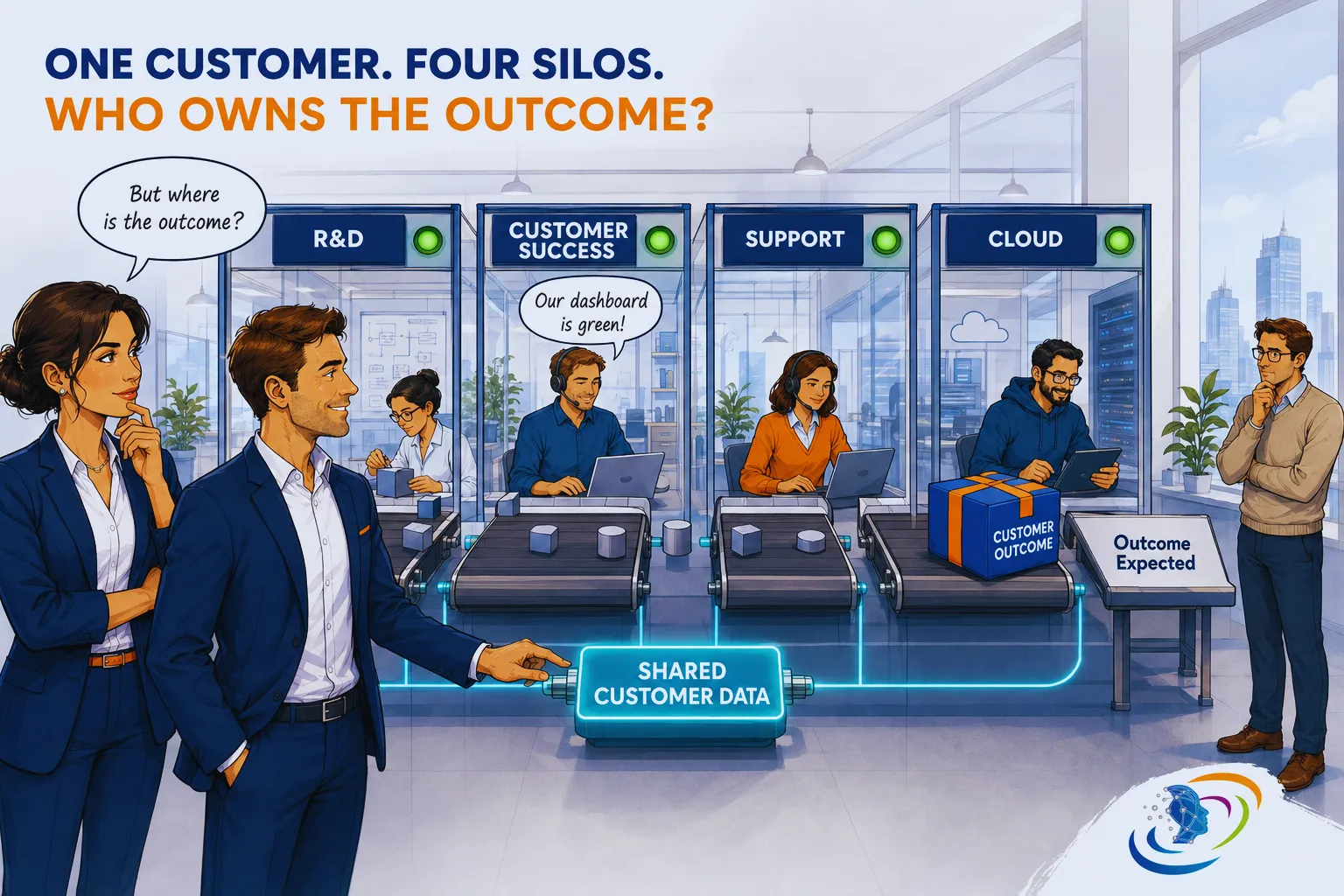
One customer, one outcome, four departments. How R&D, customer success, support and cloud became four separate factories, and why the next decade belongs to the vendors that run them as a single value chain.
Twenty-six percent. As of July 2026, that is the share of enterprises that consider themselves advanced at operationalizing AI, according to a Forrester study of 397 global decision-makers. Half of them dedicate at least 5 percent of their IT budget to AI. Only 39 percent report meaningful progress aligning AI strategy, governance and operating model, and 35 percent collect no quantified AI metrics at all.
The study’s conclusion deserves to be pinned on every executive floor: AI scaling is no longer a technology problem. It is an organizational one.
For software vendors, I would push the argument one step further. The biggest obstacle between your company and the value your customers are waiting for is not your model, your roadmap or your budget. It is your org chart. Your customer buys one outcome. You sell them four departments.
The four factories
Look at how a software vendor is actually organized, not on the values page but in the operating reviews.
- R&D optimizes velocity and roadmap delivery. Its quarter is good when features ship on time and the backlog burns down. Whether those features moved any customer’s business number is, at best, someone else’s slide.
- Customer success optimizes adoption and renewal. Its quarter is good when health scores are green and the renewal forecast holds. As I argued in my last two editions, those health scores too often measure the vendor’s comfort rather than the customer’s result.
- Support optimizes ticket closure and time to resolution. Its quarter is good when the queue is short. The strategic information buried in those tickets, which features break, which workflows confuse, which customers are silently struggling, rarely travels anywhere.
- Cloud operations optimize uptime and consumption. Their quarter is good when the platform is stable and usage grows. The question of whether that consumption is producing value for the customer, or just cost, belongs to nobody.
Four functions, four dashboards, four definitions of a good quarter. Each one is locally rational, staffed with competent people, and defensible in isolation. The sum is a company that is structurally incapable of owning its customer’s outcome.
Now look at what the customer experiences: one product, one invoice, one outcome that either materializes or does not. The customer does not care which of your factories dropped the baton. They experience every seam in your organization as a defect in your product.
How silos manufacture the customer tax
In my previous edition I proposed a test: would your customer pay for this interaction if it were unbundled and optional? If not, it is a tax hidden inside the contract. Run that test seriously and a pattern appears. The taxes are manufactured at the seams between silos.
The QBR that reports activity instead of outcomes exists because the CSM has no access to the outcome data sitting in product telemetry and cloud consumption. The escalation process the customer pays for in time and frustration exists because support and R&D have no shared loop. The premium success tier exists, in part, to fund humans whose real job is to compensate for information that the vendor’s own departments do not exchange. The customer ends up paying twice: once for the software, and once for the vendor’s internal fragmentation.
This is worth saying plainly. Most of what customers dislike about dealing with software vendors is not malice and not incompetence. It is seams.
The AI era’s double exposure
Silos have always cost money. Two forces are now changing their price.
- The first is internal. AI runs on end-to-end data. An agent that helps a customer succeed, whether it drives onboarding, anticipates risk or proposes the next best action, needs the support history, the product telemetry, the consumption curve and the outcome baseline in one place. Forrester found that 38 percent of enterprises name data silos as a primary barrier to scaling AI, and 41 percent cite integration complexity. A fragmented value chain cannot feed a coherent agent. In the AI era, your org chart becomes visible in your product: customers can feel, in the quality of your automation, how well your departments talk to each other.
- The second is external, and less discussed. The customer’s AI sees straight through you. Procurement and FinOps agents already compare delivered value across vendors using the customer’s own data: what was consumed, what was resolved, what moved the business number. Your R&D, support, CS and cloud teams may never sit in the same room; the customer’s renewal analysis puts them in the same spreadsheet, netted into a single line called value received. When switching costs collapse, and AI-assisted migration is collapsing them, that single line decides the renewal.
An industry that spent two decades tolerating internal fragmentation is about to be evaluated, continuously and automatically, on the one thing fragmentation destroys: the end-to-end result.
The value chain, rebuilt
The alternative is not another reorganization, and it is certainly not another layer of coordination meetings. It is a simpler and more demanding discipline: run the four functions as one value chain, instrumented against one number, the customer’s realized value.
What does that look like function by function?
R&D gets a second scoreboard. Velocity still matters, but part of the roadmap is ranked by outcome telemetry: not what shipped, but what moved customers’ numbers. The most valuable input to that ranking is already inside the building, sitting unread in the support queue and the usage data.
Support is reclassified from cost center to signal engine. Every ticket is a labeled, timestamped piece of product truth, volunteered by the customer at their moment of maximum honesty. AI finally makes it economical to mine that truth at scale and route it to R&D and CS in near real time. Deflecting it into a chatbot and measuring only deflection rates is throwing away the richest dataset you own.
Cloud operations move from uptime to value delivery. The consumption curve is the closest thing you have to a continuous measurement of whether the customer is getting anything out of the software. Measured against outcome baselines, it becomes the evidence base for every honest renewal conversation.
Customer success becomes the orchestrator of the chain, which is a very different job from owning a book of renewals. The CS function of the AI era is a value instrumentation function: it holds the customer’s baseline, reads the unified telemetry, and pulls R&D, support and cloud into the value conversation with the authority to do so. Digitally delivered and AI-led for most of the base, human where the value conversation is complex.
None of this works without the foundation: one shared customer value dataset, where product telemetry, support signals, cloud consumption and outcome baselines converge, governed like a P&L asset. Unify the data before you unify the teams. Agents and rituals build on top of it, not the other way around.
Five moves for the executive committee
If I were structuring this for an executive committee this quarter, five moves.
- Name the owner of the customer’s outcome. If four functions each own a quarter of it, nobody owns it. One accountable owner per account or segment, with cross-functional authority, not a coordination role. Where that owner sits matters less than the fact that they exist and can move the other three functions.
- Build the shared customer value dataset first. This is the 38 percent problem, and it is solvable in quarters, not years. Product telemetry, support history, consumption, outcome baselines: one customer, one record, one access model.
- Put one customer number on every dashboard. Each function keeps its operational metrics, but R&D, support, CS and cloud all report against the customer’s realized value. Review it together, in one meeting, on one page. What the four factories share is the point.
- Rewire one incentive per function. Not a big-bang compensation redesign: one outcome-linked component each. A portion of R&D’s roadmap scored on customer impact. A support bonus tied to signal quality, not just closure speed. A cloud objective on realized value per consumed unit. A CS plan weighted toward outcome attainment rather than renewal mechanics.
- Let AI do the integration humans never managed. Cross-silo visibility used to require committees, liaison roles and goodwill. An agent reading support, telemetry and consumption together produces the end-to-end customer picture that twenty years of steering meetings never did. Pilot it on ten strategic accounts, publish the picture internally, and watch how quickly the four factories start behaving like one company.
The org chart, redefined
The vendors that win the AI decade will not be the ones with the best features per silo. They will be the ones their customers experience as a single system, organized around the customer’s result, and able to prove that result in the customer’s own numbers. Functional excellence built the software industry. It will not carry it through the next decade. The org chart is the last silo, and it falls next.
This article is adapted from edition #12 of my LinkedIn newsletter, Professional Services & Tech. Subscribe on LinkedIn to receive future editions.
Sources:
FPT Software and Forrester, “From Pilots to Reusable Platforms: A Blueprint for Scaling Enterprise AI” (July 2026);
McKinsey & Company, “Introducing customer success 2.0: the new growth engine”; McKinsey & Company, “Making collaboration across functions a reality”.
Mathilde HENRY
Executive Leader in Enterprise Software & AI Transformation. 20 years working at the intersection of software, consulting and business transformation.