




The rescue: why restructurings led from the top fail the week the leader looks away
Private equity replaces most portfolio company CEOs during the hold. The leaders who create lasting value are not the ones who fix everything themselves, but the ones who make the company readable, and fixable, by others.
Sixty-five percent. According to AlixPartners' 11th Annual Private Equity Leadership Survey, published in March 2026, nearly two-thirds of private equity firms replace portfolio company CEOs during the holding period, and only 9% say they rarely do. Earlier research by the same firm found that 83% of PE executives believe unplanned CEO turnover lengthens holding periods, and nearly half say it reduces returns.
Leadership change has become a defining feature of PE ownership. The reasons vary, but one pattern is particularly expensive, and I have seen it from the inside: a leader carries the company personally, the numbers improve, and when that leader leaves or looks elsewhere, the company resets. Nothing had been installed that outlived her.
For services firms under LBO, IT services, consulting, digital agencies, I would push the argument one step further. The job at the top is not to fix the company. It is to make it fixable, by others, every week, until the exit.
Growth outruns legibility
Almost every services firm that needs restructuring got there the same way: by succeeding. Revenue grew faster than the machinery built to run it. Acquisitions were bolted on, each with its own staffing habits, its own margin culture, its own idea of what "on track" means in a project review. The leader at the top held it together by personal effort: knowing which client was unhappy, which project manager to call, which number in the monthly pack was not quite true.
Then one day a board asks a simple question. What is our real margin by contract? Which accounts are we losing money on? How many of our consultants are billable next month? And the organisation needs three weeks to answer. That silence is the moment an investor starts to lose confidence. Usually not in the business. In its legibility.
The rescue
What follows is what I call the rescue. A strong leader takes everything into her own hands. She reviews every deal, signs every hire, attends every escalation. Within two quarters the numbers improve and everyone is relieved. Eighteen months later, when her attention moves elsewhere, the organisation slides back to where it started, because nothing had been repaired. It had only been carried.
I know this pattern well because, early in my career, I ran a rescue myself. It worked for exactly as long as I was in every meeting.
The capital problem of a restructuring is not cost
We tell ourselves the restructuring problem is cost. Or pricing. Or the wrong people in the wrong seats. Those are symptoms.
The root problem is legibility. In a services business, cost is not a line you manage. It is the output of thousands of small decisions made every week: who gets staffed where, which scope creep gets absorbed, which discount is granted to close the quarter. You cannot cut your way to a different cost base if the decisions that produce it stay the same. You can only reduce headcount and watch the same decisions rebuild the same cost structure, with fewer people to absorb it.
Here is the asymmetry nobody prices in. When a firm has a few dozen consultants, the time between a project going wrong and the leader knowing about it is measured in days. At several hundred consultants spread across countries and acquired entities, it is measured in quarters. The business did not become worse as it grew. It became slower to tell the truth about itself. And a board cannot steer what it cannot read.
Look at what a typical restructuring plan contains: a new org chart, site consolidation, headcount targets, shared services, a harmonised rate card. And the single thing that determines whether the new structure holds, who decides what, on the basis of which number, and how often, is designed by no one. The operating cadence is the restructuring. The org chart is only the drawing.
What I had done, rather than what I did
When I took over Professional Services at Adobe, the strategic problem was not visible in any single project. Delivery economics varied widely from one region to another. Every project rebuilt from scratch what the previous one had already built. Services growth was capped by headcount, which meant every additional point of revenue cost almost a point of margin.
The obvious move was for me to redesign the delivery model myself. I did not. I named owners rather than workstreams: one leader became accountable for reusable delivery assets, with a budget and the authority to refuse regional teams who wanted to rebuild their own version. I installed one weekly operating review, one page, the same numbers for every region: margin by contract, forecast accuracy, backlog, utilisation. Any number that moved had an owner in the room to explain it. And I kept for myself only the decisions nobody else could take: stopping a project that was burning margin, arbitrating with sales on scope, protecting the investment in reusable assets when a quarter got tight.
The team built the accelerators. The regions adopted them because the weekly numbers made the difference impossible to ignore. Over that period delivery costs fell by 35 percent, services revenue grew by 20 percent and revenue per contract by 15 percent.
I did not build a single one of those accelerators. My contribution was deciding that they would exist, choosing who would own them, and making sure the whole organisation could see, every week, whether they were working.
Key-person risk is an exit discount
The objection is predictable. A fund that has lost patience wants speed, a leader who takes things in hand, visible action in the first hundred days, not a new meeting cadence.
The fund does want speed, and it should. But visible heroics build a company that depends on one person, and that has a name in a data room: key-person risk. At exit, the buyer's due diligence asks exactly the question the board asked at the start, which is whether this business can be read and run without the people at the top. A restructuring carried personally by the CEO improves EBITDA and lowers the multiple. A restructuring that installs a system improves both.
Read against the AlixPartners data, this is also the most practical answer to CEO turnover. A company whose performance lives in its operating system, rather than in its CEO's calendar, survives a change of leadership. A company that was carried does not.
Five moves for the investment committee and the CEO
If I were structuring the first year of a services firm under LBO, five moves.
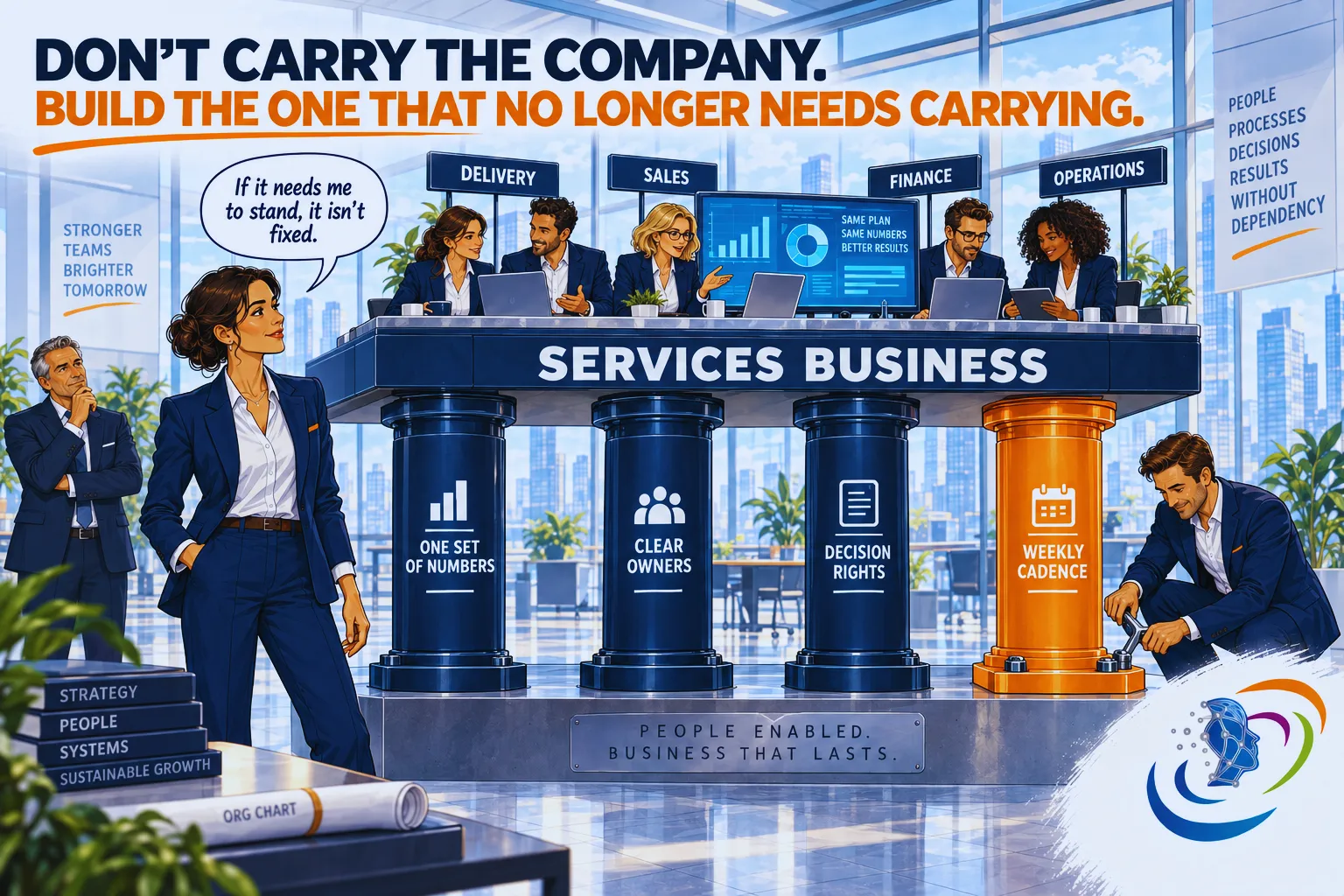
- Establish one version of the truth before any cut. The first deliverable of a transformation is not a plan. It is one set of numbers the leadership team agrees are true: margin by contract, backlog, forecast, billable capacity. Until that exists, every cost decision is a guess made with confidence.
- Write decision rights before drawing the org chart. Who decides staffing, pricing exceptions and project stops, and above which threshold each decision comes up a level. Most of the conflict that restructurings blame on people is caused by decisions nobody owns.
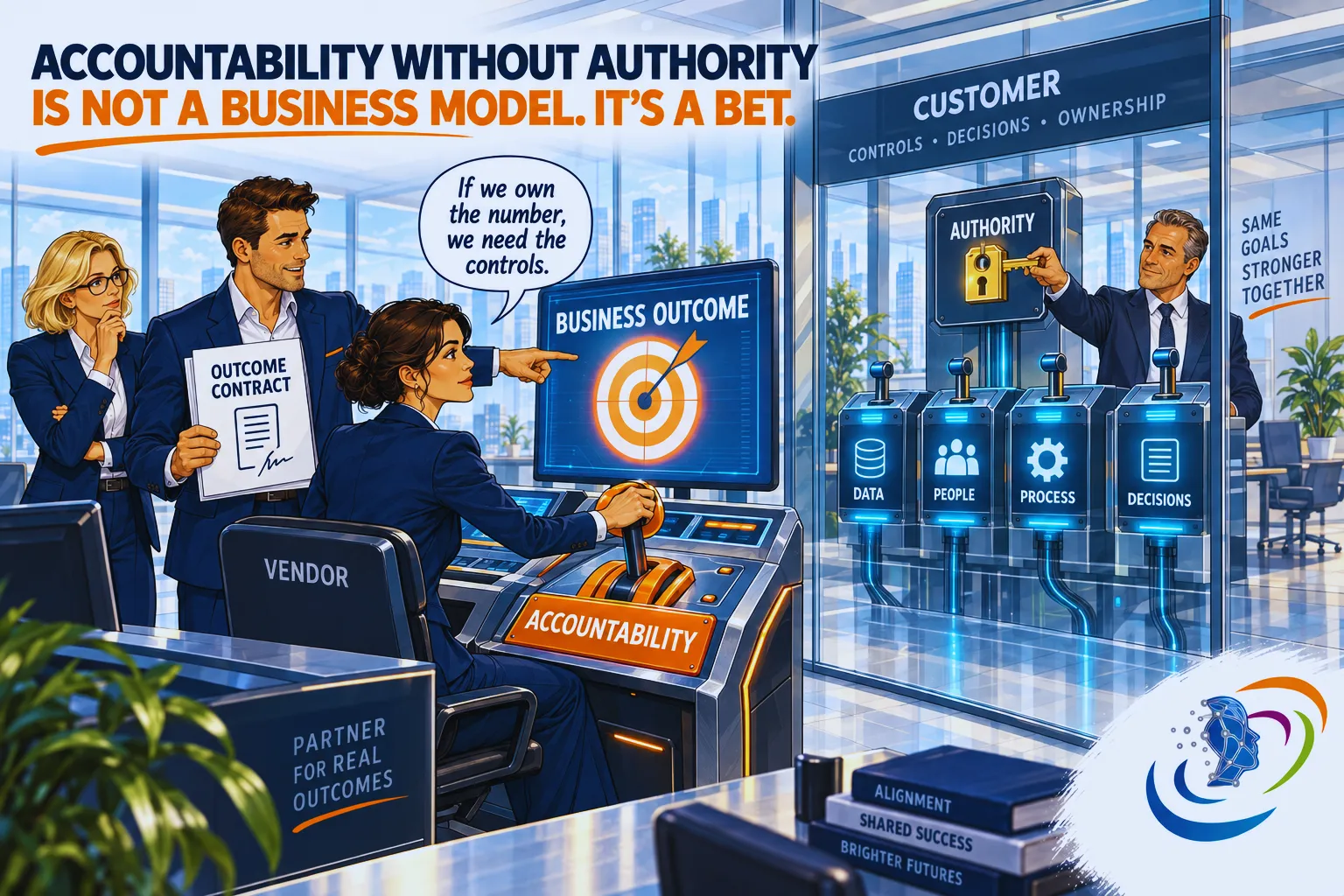
- Name owners with authority, not workstream leads. Every transformation lever gets one accountable leader with a budget and the right to say no. A steering committee is not an owner.
- Install a weekly one-page operating review that the board can read. The same indicators for every business unit and every acquired entity, reviewed at the same rhythm. The board pack becomes an extract of the operating review, not a separate exercise.
- Track escalations to the CEO as a transformation KPI. Count the decisions that reach the top each week. If the number rises, the restructuring is failing, whatever the margin says. If it falls while the numbers hold, the company is becoming worth more, and less exposed to any single leader, including the CEO.
The restructuring, redefined
Stop thinking of a restructuring as a cost programme with an org chart attached. It is a legibility programme: the work of making a company tell the truth about itself quickly enough to be steered.
The value creation plan is written in the business plan. It is delivered in the operating cadence.
Don't carry the company. Build the one that no longer needs carrying.
This article is adapted from edition #[N] of my LinkedIn newsletter, Professional Services & Tech. Subscribe on LinkedIn to receive future editions.
Sources:
AlixPartners, 11th Annual Private Equity Leadership Survey, press release, March 25, 2026;
AlixPartners and Vardis, Annual Private Equity Survey on portfolio company CEO turnover (2017-2018 editions).
Mathilde HENRY, Executive Leader in Enterprise Software & AI Transformation. 20 years at the intersection of software, consultancy and business transformation.