






The signed contract is not a victory. It's a starting line.

Growth is won after signature.
Most executive committees measure their performance at closing. Pipeline, conversion rate, signature date. That's where bonuses land, where internal celebrations kick off, where the forecasts presented to the board get built.
The problem is that valuation data tells a completely different story. A company's value is not created the moment the client signs. It's created in the eighteen months that follow. Or it's destroyed, silently, while the sales teams have already moved on to the next deal.
What the numbers say
Look at how investors actually value a company in 2026, and a pattern emerges immediately.
In SaaS, the metric that best predicts valuation multiples isn't revenue growth. It's Net Revenue Retention: the ability to keep and grow the existing customer base. At strictly identical revenue and growth, a company with NRR above 120% commands a valuation 30 to 50% higher than a company at 100%. Ten points of NRR gained means twenty to thirty percent more valuation. On a mid-sized company, that's tens of millions.
On the private equity side, the shift is even sharper. For fifteen years, returns were built on leverage and multiple expansion: buy low, sell high, let the market do the work. That era is over. With rates staying high, organic revenue growth now accounts for the bulk of value creation, roughly two-thirds, versus barely a third five years ago. Funds no longer manage the buy-and-flip. They manage the operational execution of the companies they own. According to Simon-Kucher's 2025 study, nearly eight out of ten PE leaders expect operational improvement to weigh even more heavily over the next twelve months.
And the cost of capital has raised the bar. Where 5% EBITDA growth used to be enough to deliver a decent return, it now takes twice that to keep the same promise to investors.
Translation for an executive: the easy part of value, the part you got from a rising market and a bit of debt, is gone. What's left is what you do with your customers once they're in the door.
Post-sales is not a cost center. It's the business model
This is where the real misunderstanding lives. In most organizations, everything that comes after signature, from onboarding and adoption to support, renewal and expansion, is treated as an expense line. A function to optimize, automate, shrink.
But a customer who stays and grows doesn't cost. It compounds. It brings in more every year, without the acquisition cost of a new logo, and it does so with a predictability investors pay a premium for. Conversely, churn is NRR's silent twin: the gap between 3% and 8% annual customer loss is enough, on its own, to move a valuation multiple by a factor of two to three.
In other words, a company can showcase a brilliant sales machine and destroy value continuously if it lets leak out the back what it captures at the front. Closing fills the bucket. Post-sales determines whether it has a bottom.
The blind spot isn't strategic. It's organizational
Most executives understand all of this intellectually. What blocks them isn't conviction. It's the org chart.
In a typical company, post-sales is an orphan. Sales owns the rep, tech owns the product, operations owns support, and customer satisfaction reports to a director who holds a P&L on nothing. Nobody at the executive committee level actually owns the moment where value is created. The result: every team optimizes its own piece, and the compounding engine that should connect signature to expansion is nobody's responsibility.
Four organizational decisions change everything, and none requires additional budget.
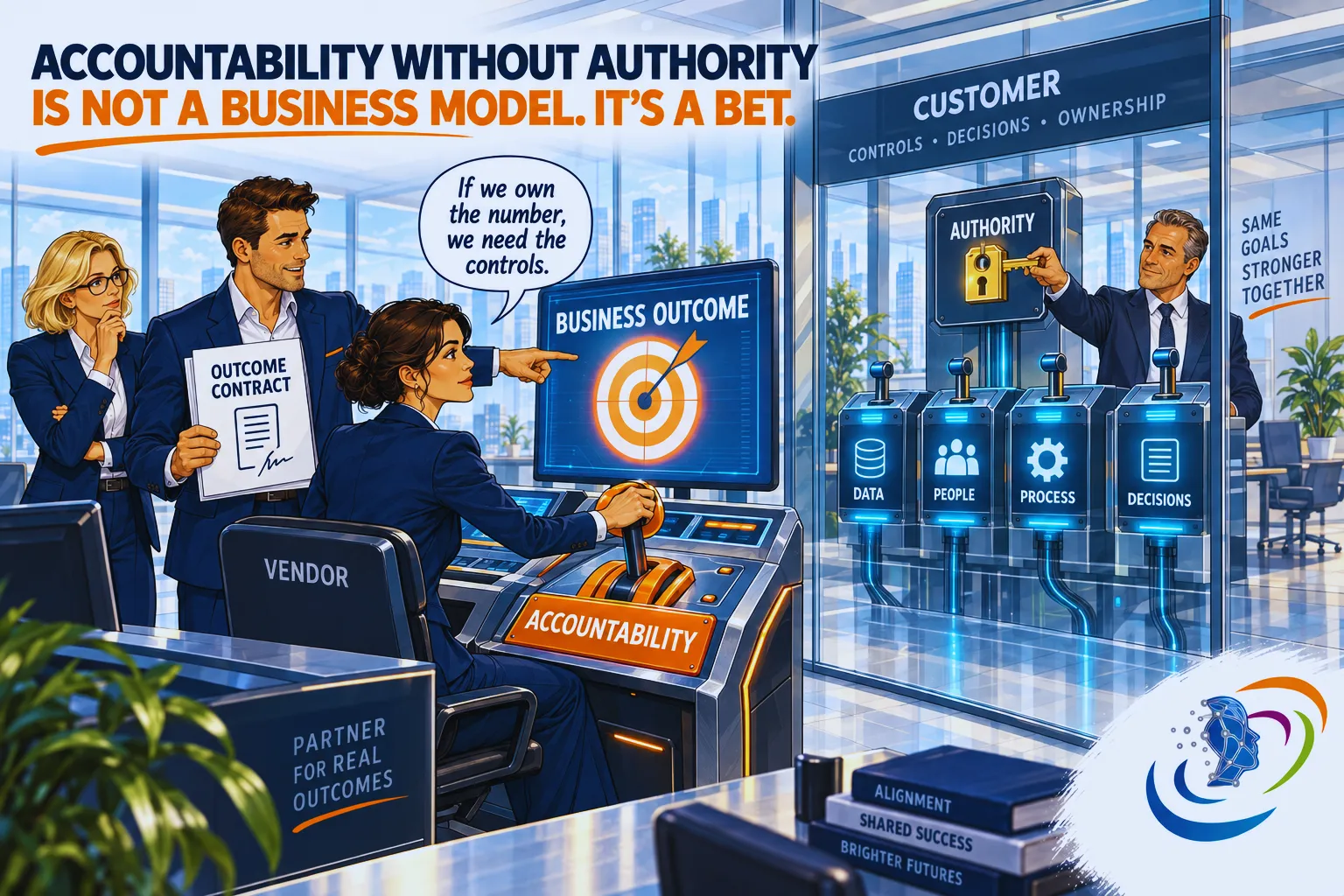
Give post-sales an owner, with a real P&L.
Not a cross-functional role with no authority, but accountability for retention and expansion outcomes, carried at the executive level. What belongs to no one gets managed by no one.
Realign compensation.
As long as 100% of sales variable pay triggers at signature, the entire company chases the wrong metric. Pay for expansion and renewal, not just the new logo.
Instrument usage before you instrument the narrative.
A company that doesn't know, in real time, which customers are adopting and which are disengaging is flying blind on its biggest value reservoir. Usage data is the post-sales dashboard.
Treat customer success as a revenue center.
As long as it reports to support and is measured on ticket volume, it costs. Attached to growth and measured on expansion, it earns. Same job, two opposite economic natures, depending on where you place it in the org chart.
What this changes for you
If you run a company, a portfolio or a practice, the consequence is concrete. The cheapest next point of growth you can buy is not in your acquisition budget. It's in your installed base, in the customers you've already convinced once and who, too often, are left to fend for themselves after signature.
The market has stopped rewarding the ability to sell. It rewards the ability to make it last and make it grow. That's a shift in the company's entire center of gravity, from the teams that close to the teams that deliver, from the acquisition narrative to the retention machine.
That is exactly what this blog will be about. How you build, and how you protect, the value that gets created after signature. No jargon, real data, and from the perspective of those who carry the P&L for it.
The signed contract is not the end of the sale. It's the beginning of the only work that actually creates value.
Mathilde Henry, Global C-Level Consulting Executive | Professional Services & Value Delivery | GenAI | SaaS | Digital Transformation | Private Equity | Pre-IPO | 9-digit P&L | Hypergrowth | Cost Efficiency