

The QBR Is Dead. What Replaces It Will Decide Your Valuation.
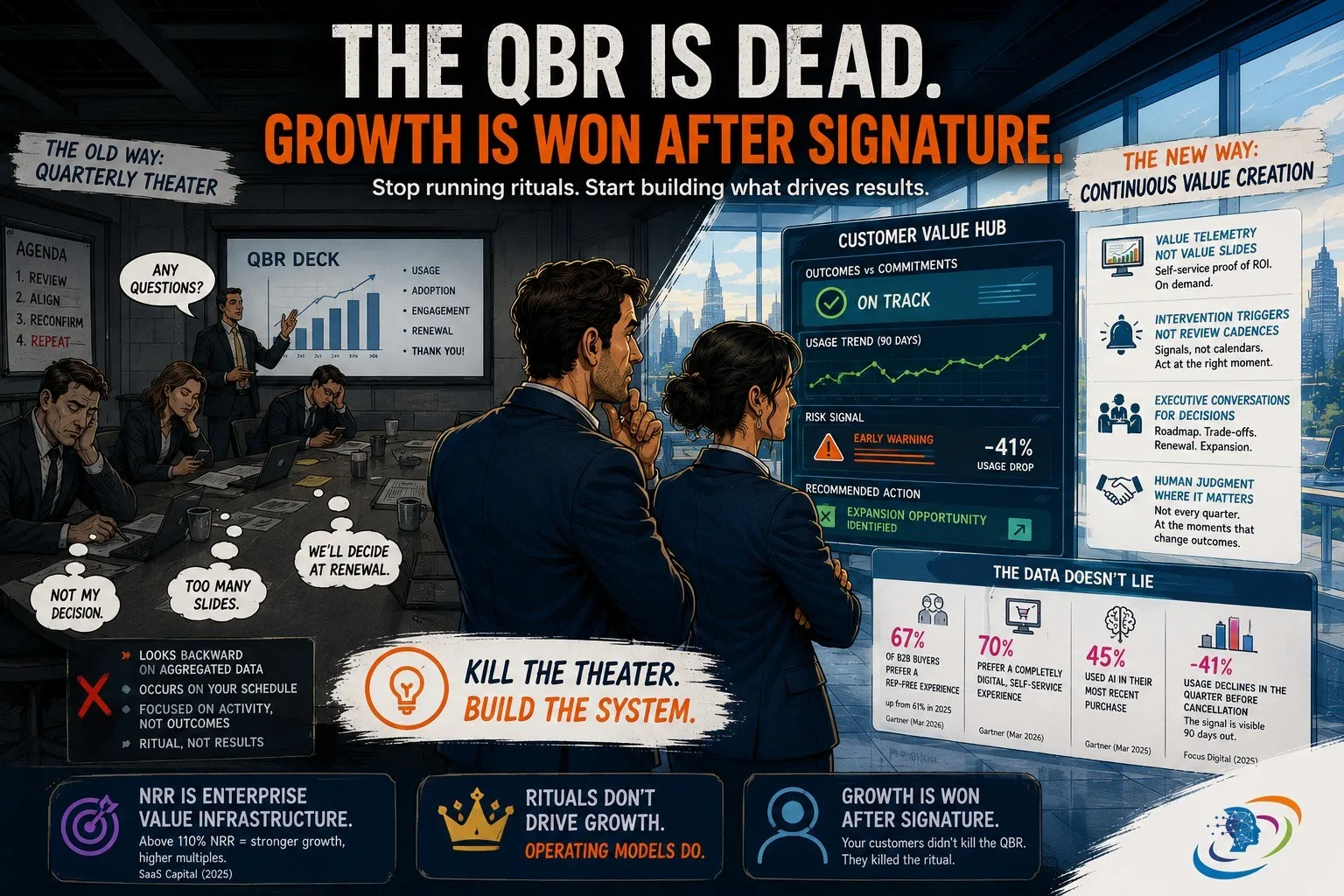
Nobody killed the Quarterly Business Review in a meeting. It died quietly, one declined invite at a time.
The executive sponsor stopped attending around the second renewal. Then the delegate started multitasking. Then your Customer Success team began measuring QBR completion rates instead of QBR outcomes, which is the corporate equivalent of taking attendance at a funeral. The ritual survived. The purpose did not.
I wrote about this in this week's edition of After Sales Mode, and the reaction told me something: most leadership teams know the QBR is broken, but very few have admitted what that actually means for how their company is governed. So this is the longer version. Not the diagnosis, the consequence.
The QBR was never for your customer
Let us be honest about what the QBR became. Forty hours of preparation per account per quarter. Slides that recycle usage dashboards the customer could pull themselves. A value narrative written by the vendor, for the vendor, presented to an audience that already made up its mind weeks ago in conversations you were not part of.
The QBR was designed to reassure the supplier, not to serve the buyer. It exists so that somewhere in your organization, someone can say value was reviewed this quarter. It is a compliance artifact dressed up as a strategic conversation. And your customers figured that out before you did.
The data says the audience has left the building
Here is the part that should worry you beyond the format debate. Gartner's latest buyer survey, published in March 2026, found that 67 percent of B2B buyers now prefer a rep-free experience, up from 61 percent a year earlier. In the same survey, 45 percent of buyers reported using AI tools during a recent purchase. Buyers are researching, evaluating and validating on their own, with software, on their own schedule.
Now transpose that behavior to post-sales. If your buyer does not want to sit through a sales meeting before signing, what makes you think they want to sit through a vendor-produced slide review after signing? The same executive who researches your competitors through an AI assistant on a Tuesday evening is not going to wait ninety days for you to tell them whether your product is delivering value. They already know. Their finance team already knows. Their AI-assisted procurement review already knows.
The quarterly cadence made sense when information was scarce and meetings were how value got communicated. Information is no longer scarce. Your customer has continuous visibility into usage, cost and outcomes. The only party operating on a quarterly information cycle is you.
Why this is a governance problem, not a CS problem
The instinctive response is to fix the format. Shorter decks. Business-outcome slides instead of usage slides. Executive summaries. I have watched companies run this playbook for a decade, and the result is always the same: a better-looking meeting that people still do not attend.
The format is not the problem. The operating assumption is. The QBR assumes that value can be proven periodically, in a session, by the vendor. That assumption is false, and building your retention motion on a false assumption is not an operational detail. It is a governance failure, and it sits with the executive team, not with the CSM who builds the deck.
Consider what is actually at stake. Median net revenue retention for private B2B SaaS has slid to roughly 101 percent according to Benchmarkit's 2025 data, down from around 105 percent in 2021. Gross retention has followed, drifting from 90 percent to about 88 percent over three years. That is the sound of expansion barely covering churn across an entire industry. At the same time, companies above 50 million in ARR now generate close to 60 percent of their new ARR from existing customers. The existing base is simultaneously your biggest growth engine and your most fragile asset, and the primary instrument most companies use to protect it is a meeting nobody attends.
Then there is the valuation layer, which is where my Private Equity readers should lean in. Companies with NRR above 120 percent trade at a significant premium to the market median, while businesses below 100 percent see their multiples compress hard. NRR is not a CS metric. It is the single purest input into enterprise value that exists in a recurring revenue business. If the mechanism supposed to protect and grow that number is a quarterly ritual with declining attendance, you do not have a Customer Success gap. You have a hole in your equity story.
What continuous value governance actually looks like
So what replaces the QBR? Not a better meeting. A different operating model. I call it continuous value governance, and it rests on four shifts that only an executive team can make, because each one crosses functional boundaries that no CS leader can redraw alone.
- First, value gets instrumented, not presented. The outcomes your customer signed for are defined at contract stage, translated into measurable indicators, and made visible to both sides continuously. If your customer has to wait for your slide to know whether they are getting value, you have already lost control of the narrative. The vendors winning renewals in 2026 are the ones whose customers can see their own ROI in real time, without asking.
- Second, value definition moves upstream. Most QBRs fail because nobody ever agreed on what success meant in the first place, so the review becomes a retroactive justification exercise. In a continuous model, the value thesis is written into the deal itself: which metrics, which baseline, which timeframe, which executive owner on each side. Sales signs it. Delivery inherits it. That handshake is a C-level design decision about how your company sells, and it cannot be retrofitted by post-sales teams after the ink dries.
- Third, escalation replaces cadence. Meetings still happen, but they are triggered by signal, not by calendar. Value tracking green and stable? No meeting, and your customer will thank you for the hours back. Adoption stalling, sponsor gone quiet, usage decoupling from spend? That triggers an executive conversation this week, not a slot in next quarter's QBR queue. Gartner's own research found that buyers who reach genuine confidence in the value of a decision are twice as likely to report a high-quality purchase. Confidence is built by responsiveness at the moment of doubt, not by reliability of scheduling.
- Fourth, the account narrative becomes machine-maintained and human-escalated. This is where GenAI stops being a buzzword and starts being an operating leverage. Continuously assembling usage data, outcome metrics, support signals and stakeholder changes into a live value narrative is exactly the kind of work AI now does better and cheaper than a CSM burning two days a quarter in PowerPoint. The human role shifts upward: interpreting the signal, owning the executive relationship, making the judgment call. That reallocation changes your post-sales cost structure and your talent profile at the same time, which is precisely why it belongs on the executive agenda and not in a team retrospective.
The uncomfortable question for the C-suite
Here is the test I put to leadership teams. If you deleted every QBR from every calendar tomorrow, would your ability to prove value to your customers actually change? If the honest answer is no, the QBR was theater and you can stop funding it. If the honest answer is yes, then your entire proof of value depends on a meeting format your customers are actively disengaging from, and that should terrify you more than the theater.
Either way, the conclusion is the same. The QBR is not worth saving. What is worth building is a post-sales operating model where value is visible continuously, owned at contract level, escalated on signal and amplified by AI. That is not a Customer Success initiative. It is a redesign of how your company governs the revenue it has already won, and in a market where the median SaaS company barely holds 101 percent NRR, it is the difference between a business that compounds and a business that leaks.
Your customers killed the QBR. They did you a favor. Now do the executive work the QBR was letting you avoid.
This article expands on this week's edition of After Sales Mode, my newsletter on post-sales strategy, value delivery and enterprise value creation. Growth is won after signature.
Mathilde Henry — Global C-Level Consulting Executive | Professional Services & Value Delivery | GenAI | SaaS | Digital Transformation | Private Equity | Pre-IPO | 9-digit P&L | Hypergrowth | Cost Efficiency